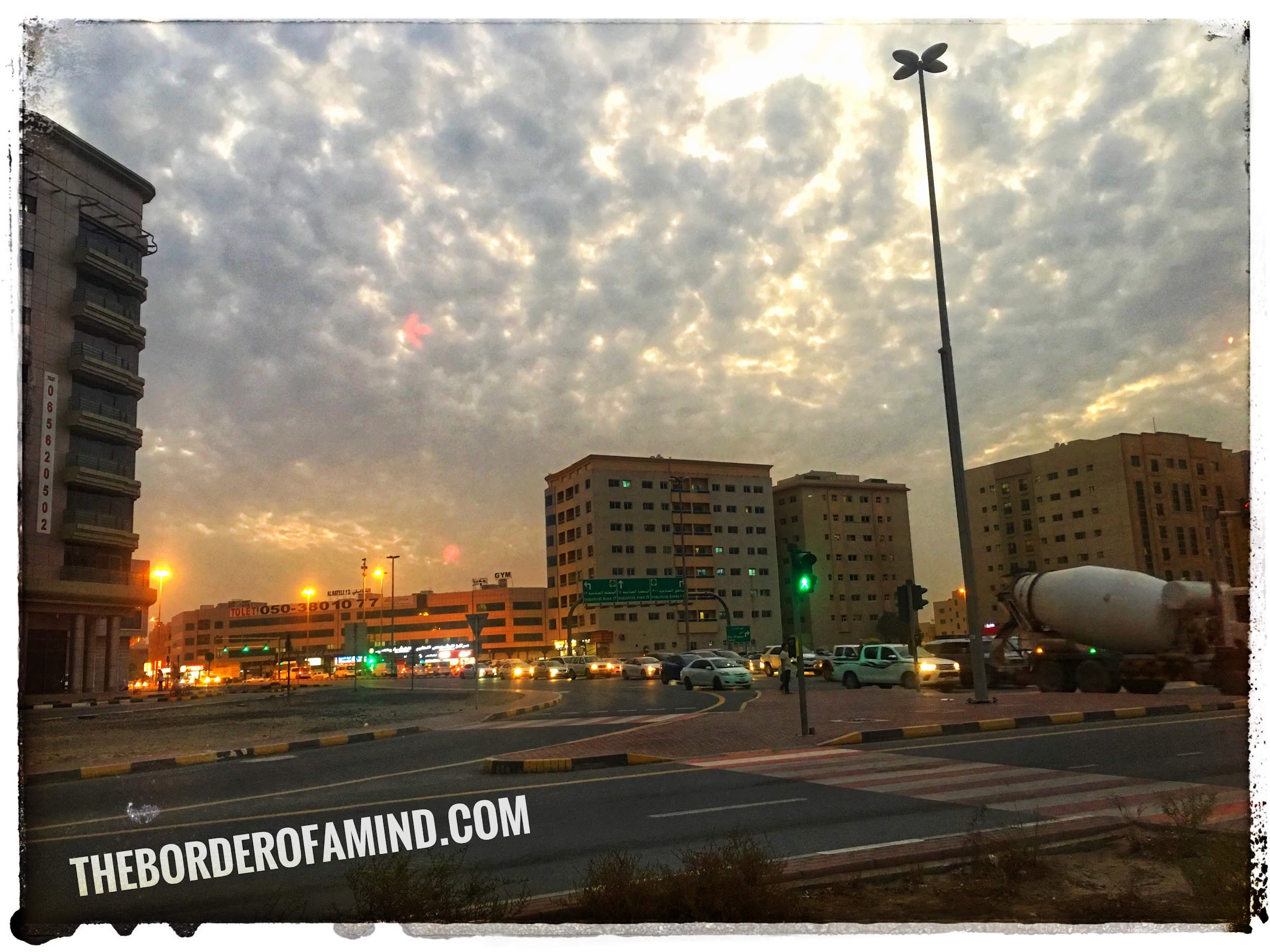
/ˌanəmˈniːsɪs/. The title of this post is from the late 16th-century Greek word anamnēsis related to ‘remembrance’. Clouds and sunset light playing a symphony of art in a winter evening at Sharjah, UAE. November 2019.
“A lot can happen in a year. People die. You outgrow old friends and get tired of mundane jobs. New careers come. New friends find your soul. But no matter what, you grow, you lose your mind a bit and most importantly you get a little wiser. Your circle gets smaller because you get stricter with your energy and time, If you are really lucky, you’ll find love inside yourself, inside of friends and family, and just maybe the universe will bless you with a lover that laughs at your really lame jokes.” .S. Mcnutt
Netta shared this recently and it resonates well. Regardless of where we belong and what we do, it’s worth to have a reminiscence of what changed in one year. Need not be always the specific things mentioned in the above quote. It can be anything and could be even related to how you respond to situations, your thought process, the way you plan things, the priorities you weight in on, people you engage and rely on, the general attitude towards events, etc. For me, personally, I believe it has been by and large about stepping back and striving to be more thoughtful in my responses, not to be too impulsive in general terms, making time for building this site by putting in more content and sharing writings, trying to be more positive, being diplomatic and to have a cohesive spirit of togetherness in responses, setting compassionate boundaries, and an earnest attempt to be more professional and objective in my professional assignments. This may be, also one of the years where some personalities whom I admire for their creative pursuit and passion had the biggest influence in me in terms of the time I spent and also the actions they actuate in all that I do. It was also the year when Genie’s cove was set up with Netta by my side, slowly building our little space and being truly grateful for the we-time. Let’s see what next year turns out to be, God willing.
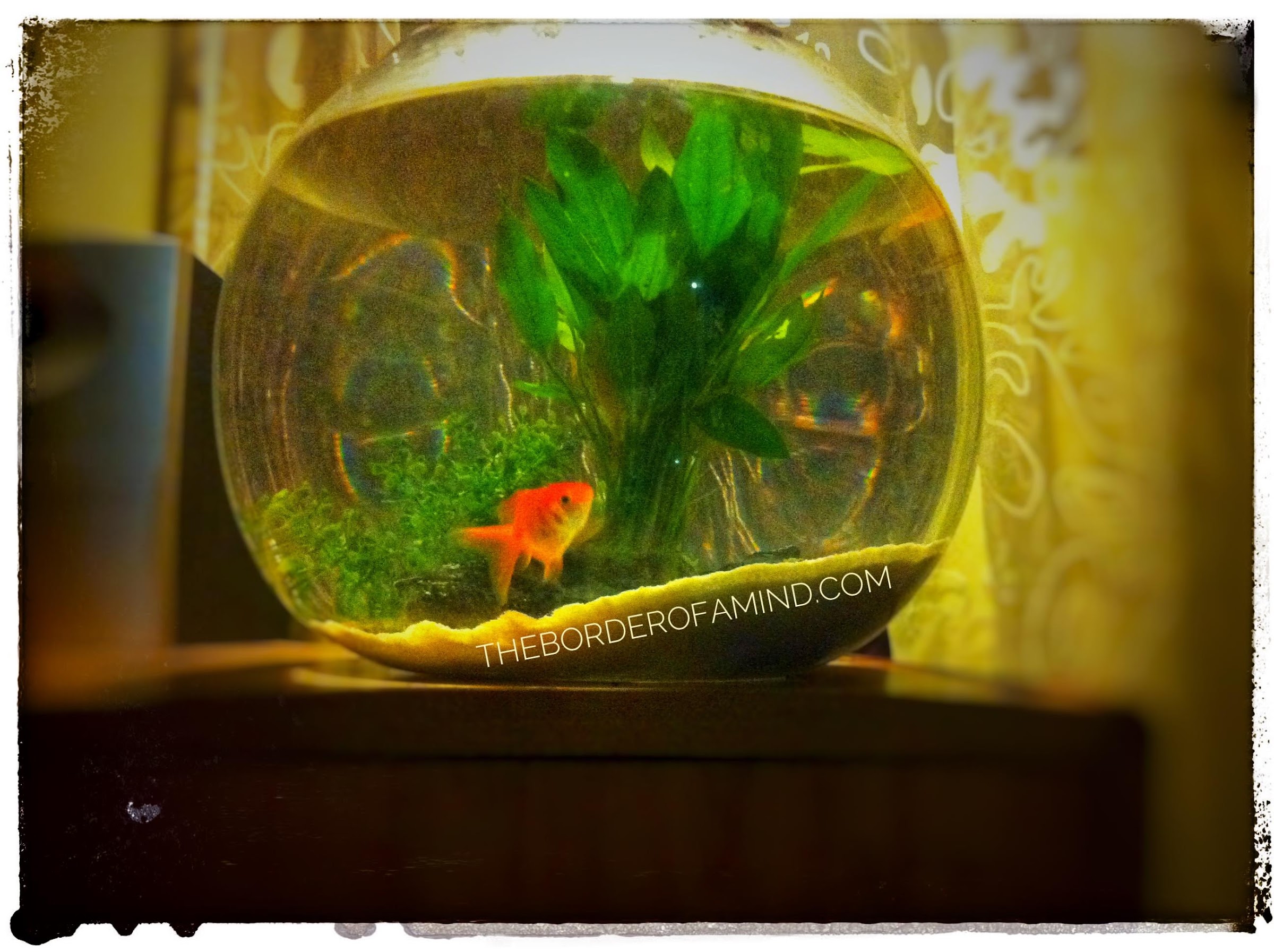
I’m a hobbyist aquarist and used to maintain and curate fish bowls many years back. In the first fish bowls, I started with plastic accessories and pebbles. Over time, I started to move on to planted setups. Nowadays I personally prefer natural components in the aquarium system. Below is a photograph from 2014. This is one of the first planted fish bowls I had built from scratch right from the sand to the plants and nice little goldfish in there.
When I used to do it in the past, I didn’t use to read or watch extensively on this art and used to have trial and error ways of building things up. I didn’t for example, had nutrients added to the sand base and didn’t read or care much about the environments required for certain types of plants.
I would like to thank MD Fishtanks for re-kindling the curiosity and inquisitiveness back in me for planted aquariums and explore aquascaping. The way he has done videos elucidating simple concepts and just the sheer art of doing it really impressed me. Ideas fueled desire and it further triggered actions and here we are with a new tank setup.
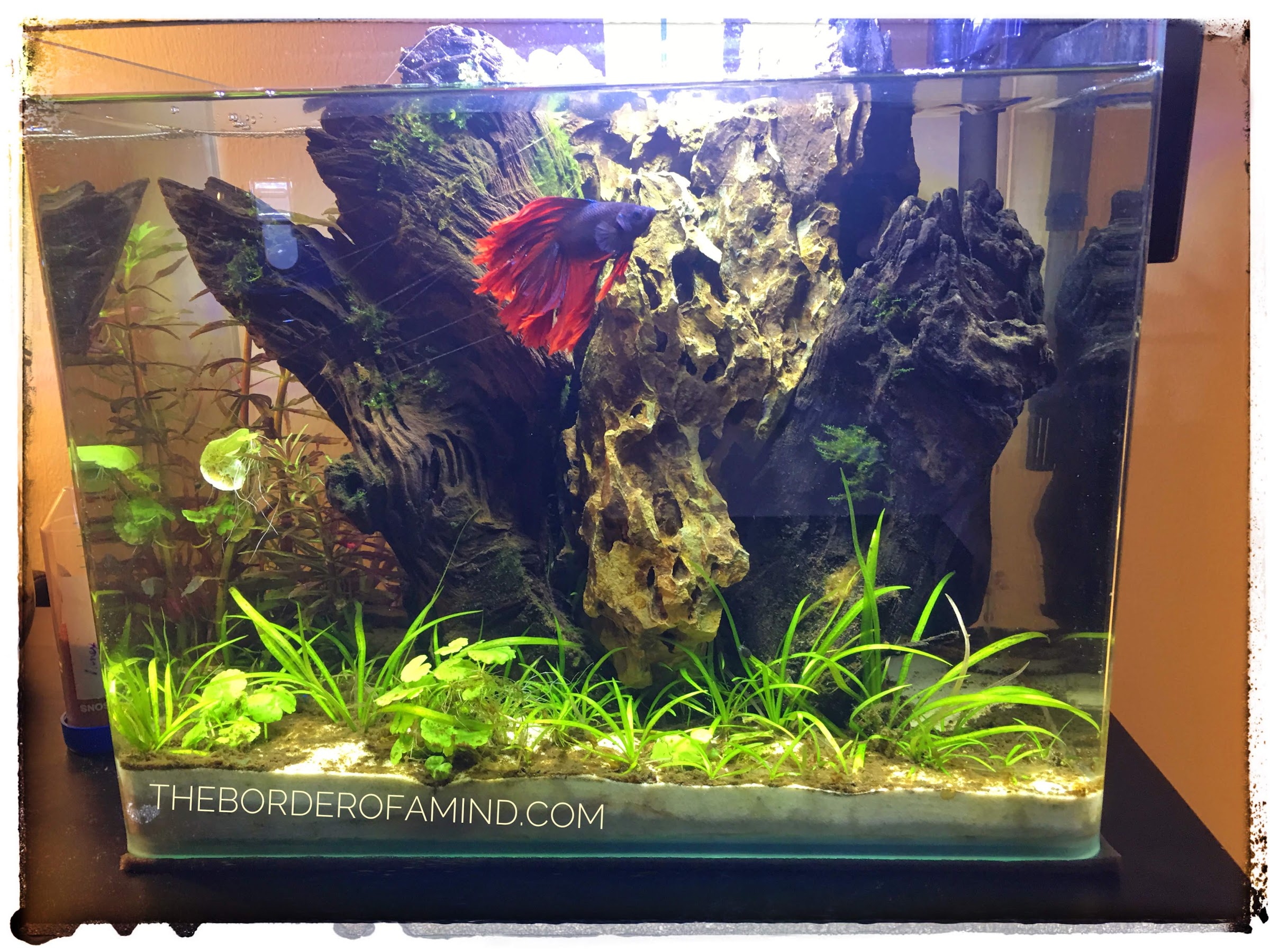
The below tank is what we have now. I did not build it. It was built by a different person and I would like to try and learn aquascaping with this setup. The fish in there is a half-moon betta. It’s a variant of a siamese fighter fish. They normally stay alone and is not compatible with other big fishes around as it might attack them. The set up has mechanical water filters (non-chemical) and some natural wood and some rocks for plant growth.
As I write this, some plants have started to have black patches on their leaves and are probably rotting. I need to find out the reasons and explore remedial measures. It’s a pretty long learning process and I would like to try to post some updates in the future.
As of now, the primary focus is to have the below:
– Understand chlorine removal from tap water and identify good less obtrusive chemicals for the same with least effect to flora and fauna.
– Understanding the importance of feeding CO2 for plants externally, preferably using a cylinder or any other external source.
– Have wood and stones re-arranged and reconfigured to have more room for fishes.
– Explore the option of putting in some guppy fishes or some neon tetra fishes.
God bless! Have you tried aquascaping techniques? Feel free to share your thoughts.
Roman Payne famously told that sunrise is the most precious gold to be found on earth. It’s a luxury that every one of us can peek at regardless of where we are or who we are. Sunrise lighting is a miraculous golden lamp that can be used to paint anything to ecstasy. If we place mountains also in this frame, what you get is pure visual bliss. We had this short stop on the way to Wadi Al Helo from the Sharjah mainland in the UAE. Travelling and riding just before sunrise through the mountain footways would uncloak some of the best visual memories and awesomeness you’ve ever had.
“Life. This morning the sun made me adore it. It had, behind the dripping pine trees, the oriental brightness, orange and crimson, of a living being, a rose and an apple, in the physical and ideal fusion of a true and daily paradise.”
― Juan Ramón Jiménez, Time and Space: A Poetic Autobiography
“HEARTWORK ” Each day is born with a sunrise and ends in a sunset, the same way we open our eyes to see the light, and close them to hear the dark. You have no control over how your story begins or ends. But by now, you should know that all things have an ending. Every spark returns to darkness. Every sound returns to silence. And every flower returns to sleep with the earth. The journey of the sun and the moon is predictable. But yours, is your ultimate ART.”
― Suzy Kassem
“With a bound, the sun of a molten fiery red cam above the horizon, and immediately thousands of little birds sang out for joy, and a soft chorus of mysterious, glad murmurs came forth from the earth; the low whispering wind left its hiding-place among the clefts and hollows of the hills, and wandered among the rustling herbs and trees, waking the flower-buds to the life of another day.”
― Elizabeth Gaskell, Ruth
Google Photos definitely is an industry game-changer. Over the past few years, it has completely revolutionized the way in which people organize and curate their photo archives. Powered by world-class artificial intelligence and neural networks, Google photos take photo organization and curation to the next level and also allows an option for unlimited storage of photos. As many of you might be aware, we can search for specific items or entities *within* a pool of photographs and you can get quick results. You can combine the searches with a lot of other keywords like familiar faces, location or other metrics. Different people use it tailored to their requirements. You can use it in a novice fashion or you can even delve into the depth of the system to use several features.
I’m sharing three uses of Google photos that are often unused by many.
Tapping the potential of Google Lens.
Using Google lens to identify and copy text in a photograph. As their website puts it, it is basically “searching what you see”. Google Lens is an image recognition technology developed by Google, designed to bring up relevant information related to objects it identifies using visual analysis based on a neural network. [ Link ]
The below screenshots are for some demonstration:
When you open the image and click on the magnifying lens icon in Google Lens, it’ll read through the image and find possible correlations depending on the context. For example, in the first image below, we have a beautiful bougainvillea flower and when we tap on it with google lens, it provides some contextual information and provides details about it. In the second image, when we click on the photograph of a car, it recognizes the model of the car and shows some relevant information. That’s really helpful.
Similarly, we can copy text from an image file containing text content. For instance, please see the below image. It has text in it and Google photos can be used to copy text from that image and you can even translate it right away. How cool is that!
Try some searches in Google Photos, using terms common and obscure. Google’s auto-tagging of images is pretty amazing, beyond just the face recognition (which I found could ID people in photos even if they’re in the background). For example, a search of the term “dog” got just about every image I could conceive of with my pups in the pics—even some with just a pup statue or paw. I didn’t tag any of those pics with “dog” or “statue,” by the way: Google just knows.Location searches are also easy with geo-tagging, making it easy to find, say, all your vacation pictures at once.
Using Google Photos to embed images in blogs or websites.
Inherently, by design, Google doesn’t explicitly advertise itself as an image host service for blogs and websites. Considering that the entire repository of our photographs are archived at Google photos, it makes a nice photo host. Labnol has released a nice little tool to embed Google photo images into blogs and websites. Once you copy-paste the public link from the image, paste it into the website of the tool and it’ll generate an embed code that you can put on your blog or site.
I happened to read this share from Netta recently. We can easily relate instances wherein *boredom* sets in and sabotages a goal we had. This can often permeate for short term or even long term plans.
“The greatest threat to success is not failure but boredom. We get bored with habits because they stop delighting us. The outcome becomes expected. And as our habits become ordinary, we start derailing our progress to seek novelty. Perhaps this is why we get caught up in a never-ending cycle, jumping from one workout to the next, one diet to the next, one business idea to the next. As soon as we experience the slightest dip in motivation, we begin seeking a new strategy—even if the old one was still working. As Machiavelli noted, “Men desire novelty to such an extent that those who are doing well wish for a change as much as those who are doing badly.”
– James Clear, “Atomic habits”
Setting a goal or a vision often gets accompanied by an action roadmap that includes small incremental achievable actions that count on to gradually achieve the vision or goal we had in our minds. My experiences and intuitions have induced me not to be stagnant at any stage and always be proactive and positive with incremental steps towards a goal set. Of course, we go through slips that are human by nature. It’s often in these small cumulative steps that we often stumble and fail in walking towards a dream or purpose. While writing this, I recollect an interesting conversation that I had listened to sometime in 2016, between Walt Mossberg and Jeff Bezos wherein Jeff mentioned his keenness to be “stubborn on the vision, but flexible on the details“. Maintaining enthusiasm towards the end of a long term project or objective is paramount. What is more interesting is that it is in these small gradational steps or stages wherein the passion for working towards a dream is to be invigorated. Seeds of boredom often enfeeble these small steps that we embark on and gradually jeopardize the goal. That’s probably the reason why the single most important thing in working towards a vision is to systematically and consistently maintain the enthusiasm throughout. Within the bounds of our inherently humane weaknesses, when someone gets through, that’s how greatness sprouts. Dreams are often lost in the details. In fact, details and path embarked are cardinal in major fulfillments. May passion and fervor fuel your hopes and aspirations. God bless friends! : )
When we go somewhere, between all the rush and the hustle and bustle are those sweet little moments in time that’d be chiseled in our memories. I and Netta traveled to Al’ Ain and Ghubaiba (old city of Dubai) and I thought to extract some memorable frames into a short moving picture.
Music by Canadian Singer Dawud Wharnsby.
“The Remnants We carry small membranes of memories Within us As do trees, flowers, stones, All life force around us
Fragments of memories Engraved in chips of iron, copper, silver… Interlaced in the workings of men Intertwined into the streets, buildings The networks around us
Pathways between ages Each carrying their Remnants of the past”
― Maria Lehtman, The Dreaming Doors: Through the Soul Gateways
Before I start, let’s see this beautiful video “Nature by Numbers” by Cristóbal Vila. I first saw this almost 9 years back and it helped discover a lot of amazing knowledge treasures which I didn’t know before. This number is used by architects and designers extensively, but what we are discussing here is something else. It’s about realizing and pondering on how the entire universe is crafted specifically in a specific metric. Have a look at the video and I shall elaborate further with detailed illustrations. I was pretty pumped up when I first came to know about this and would like to take this write up as an opportunity to share this information with you. Probably this would be the first write up for which I spent the longest time preparing content and illustrations for the only reason that I’m super excited to share this all of you. Now, let’s read.
This piece would be an addition to the Ponder Series that we have been writing extensively over the past several months. When we think about the world around us and also when we look within, it might seem usual and ordinary. But ponder series, as you might know, is all about thinking deeply and delving into the details by going beyond the ordinary perceptions. “Golden Ratio” is such a concept that’ll blow our minds off. I first read about this interesting ratio pervading the universe when I was in college. I shall elucidate it here, preferably with some visual illustrations. If you have not heard about this before, I’m sure this will definitely throw you into some wonder. Read it very carefully. It’s exciting information!
Many of us would be familiar with the Fibonacci series of numbers which were discovered by the Italian mathematician Leonardo Fibonacci in 1202 B.C.
It’s a series as below:
0, 1, 1, 2, 3, 5, 8, 13, 21, 34, 55, 89, 144, 233, 377, 610, 987, 1597, 2584, …
In this series, if you add two numbers in the series, you’ll get the next number in the series. For example, 0+1=1, the third number in the series. And 1+1=2, the fourth number in the series, 1+2=3, the fifth number in the series and so on.
We might have seen this series in our maths classes and wondered what is special about them. They have an amazing property. If we divide any number in this sequence by the number before it, we would get numbers very close to each other. After the 13th number in this series, the ratio is constant and we get 1.618. This is called “Golden Ratio”
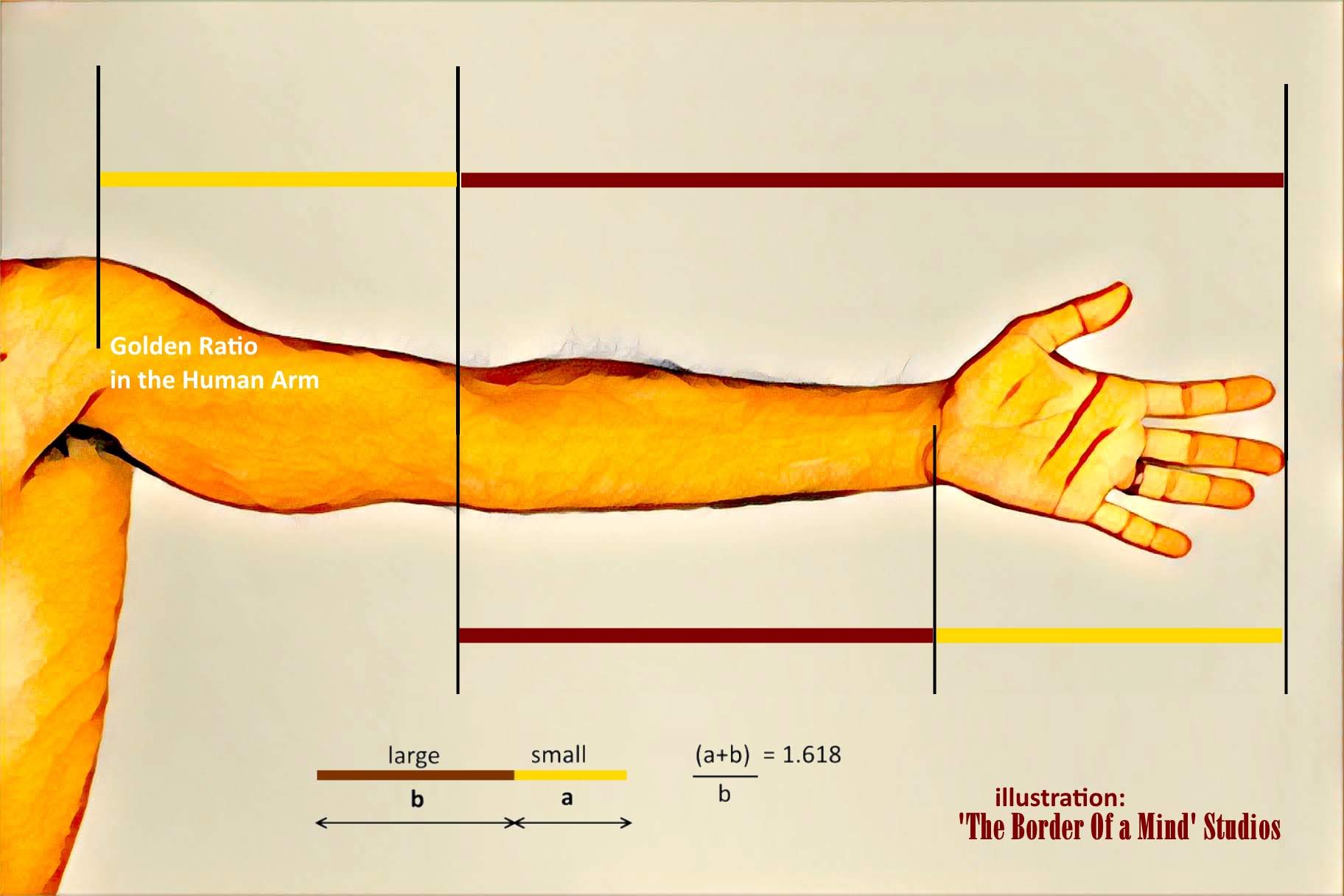
Now, this golden ratio number of 1.618 is pervading everywhere. If you didn’t know this before, get prepared to be blown away.
Human Body
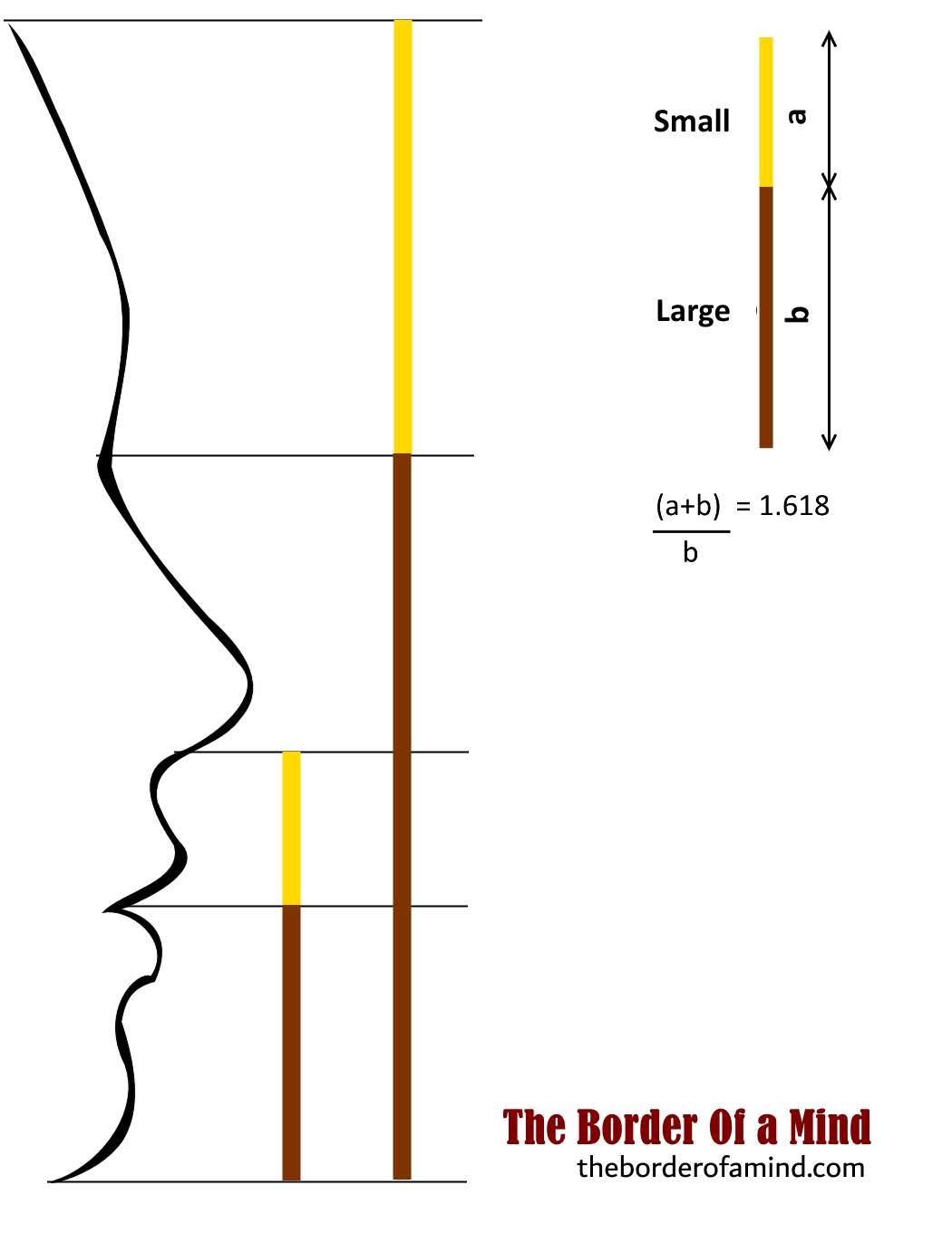
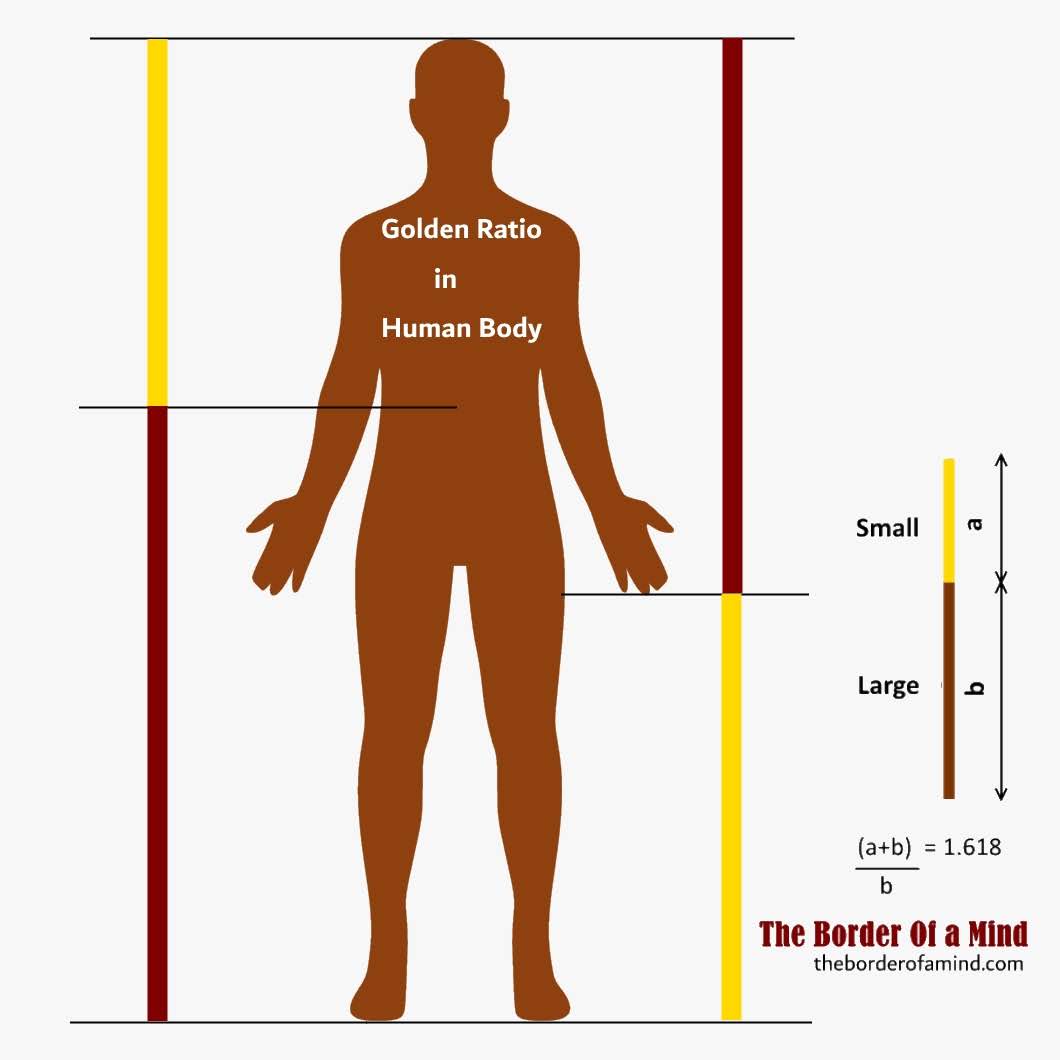
Did we ever think that our body measurements were just random? Boy! we are wrong! The proportions and geometrical ratios are carefully crafted in this specific ratio. For a better visual perspective, I’m sharing a few illustrations below so that you can take a look! These values are universally true for every human body. Isn’t that a jaw-dropping realization if you didn’t know this before?
Now, that’s far from over. Let’s go a little deeper. The same ratio is true for the below: – Length of face/width of the face, – Distance between the lips and where the eyebrows meet / length of the nose, – Length of face/distance between the tip of the jaw and where the eyebrows meet, – Length of mouth/width of the nose, – Width of nose/distance between nostrils, – Distance between pupils/distance between eyebrows.
Even the placement of teeth, as well as the ratio of individual teeth sizes, are on this same ratio.
In a research study carried out in 1987, it was discovered that this magic ratio is also in the structure of the lungs as well. The bronchi network in the lung is asymmetric. The windpipe gets divided into the left and the right bronchi networks. The one on the right is short and the one on the left is long. The geometrical proportion of the shorter one to the longer one of this bronchi is 1.618. Isn’t that amazing? Recent studies have shown that the internal structures of the ears are also proportioned in the same ratio. The more we explore and delve in, the more breathtaking it turns out to be.
This number has garnered significant interest in great minds like Pythagaurus, Leonardo Da Vinci and the famous astronomer Kepler. Leonardo Da Vinci has used it in the painting Monalisa.
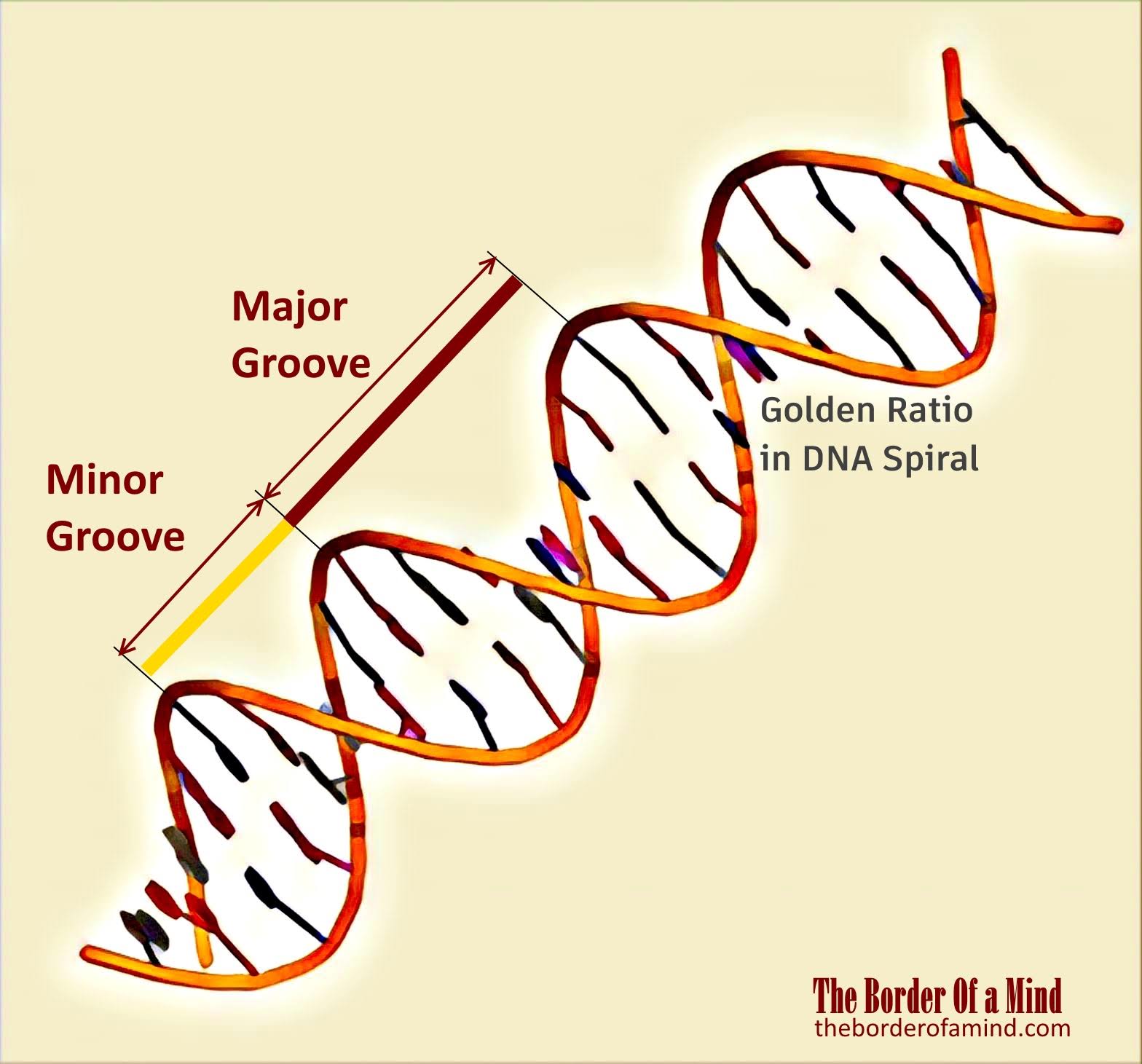
Golden Ratio in DNA Helix DNA has two grooves in its spiral. Major to minor groove proportion measures as the golden ratio 1.618.
Golden Spiral
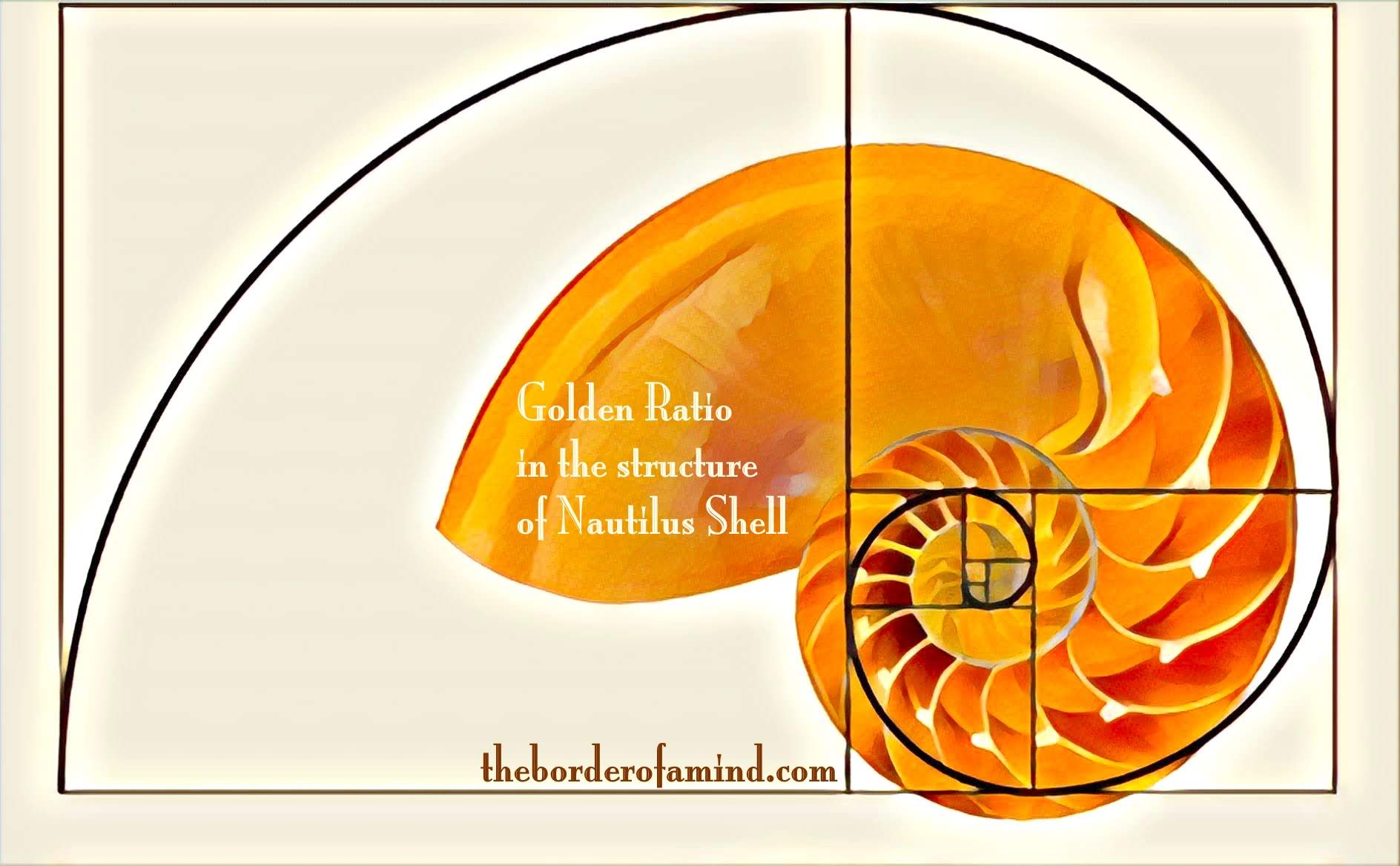
In geometry, a golden spiral is a logarithmic spiral whose growth factor is φ, the golden ratio. That is, a golden spiral gets wider (or further from its origin) by a factor of φ for every quarter turn it makes. See the below link for a reference.
Image By Jahobr – CC0, Link
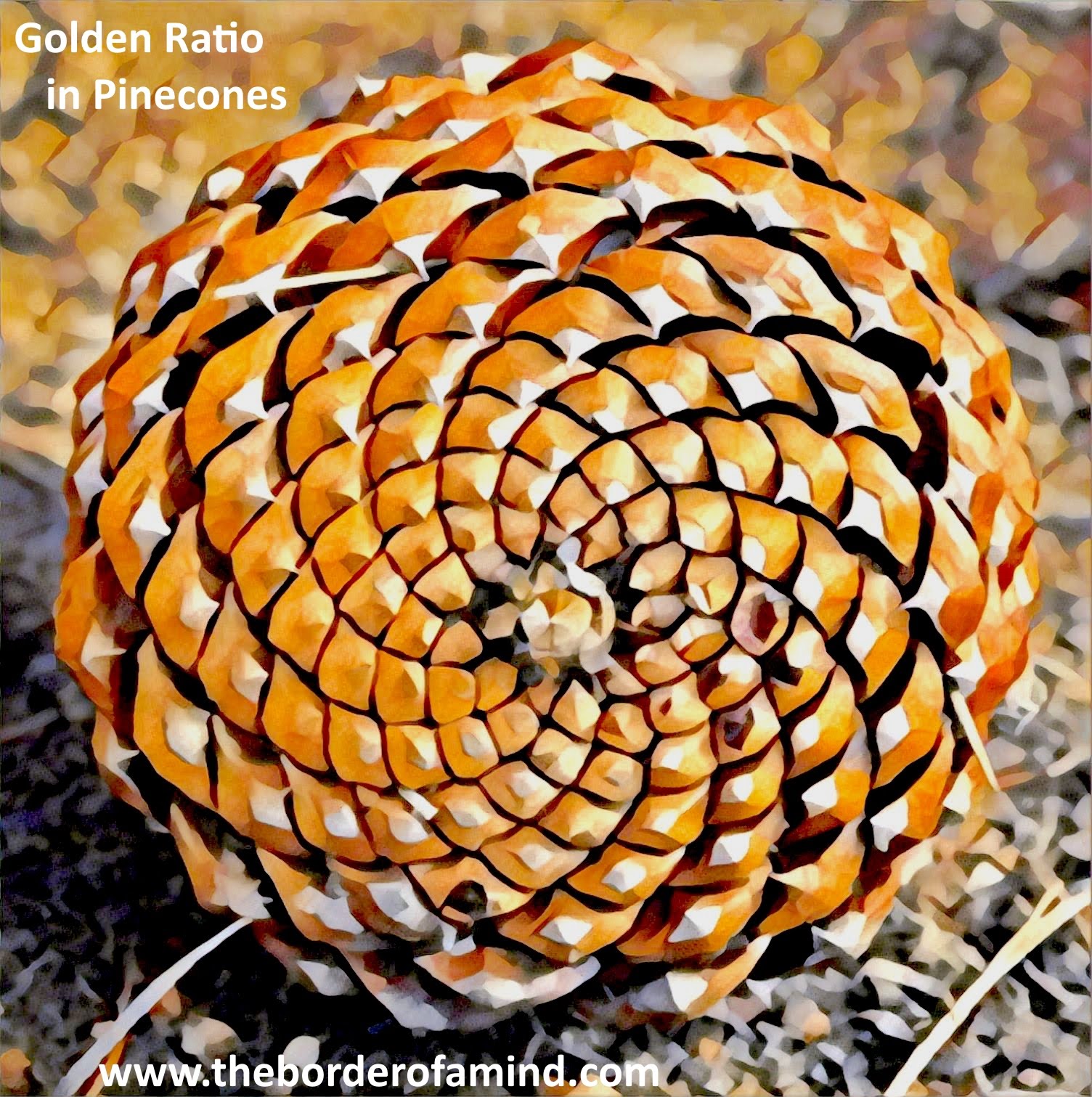
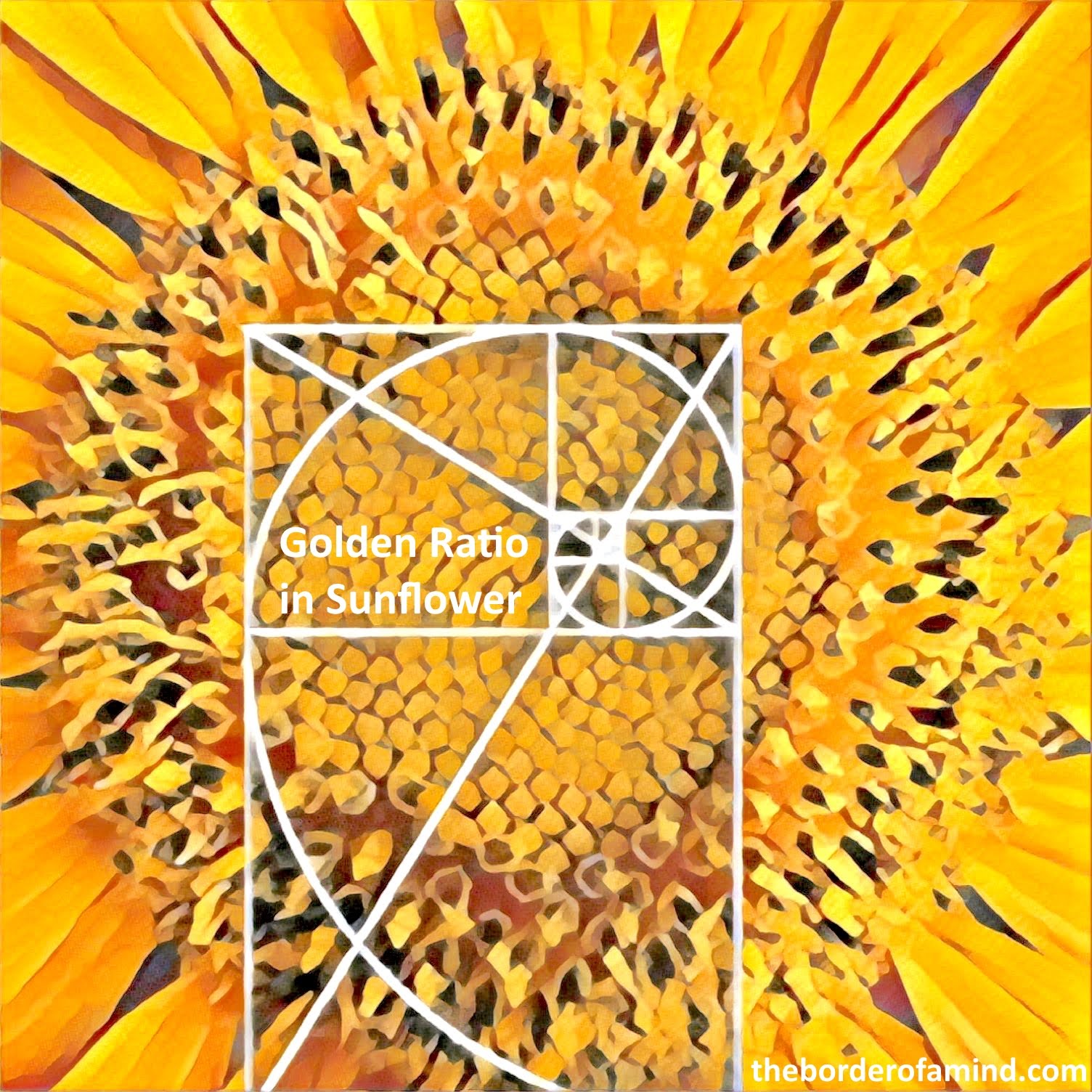
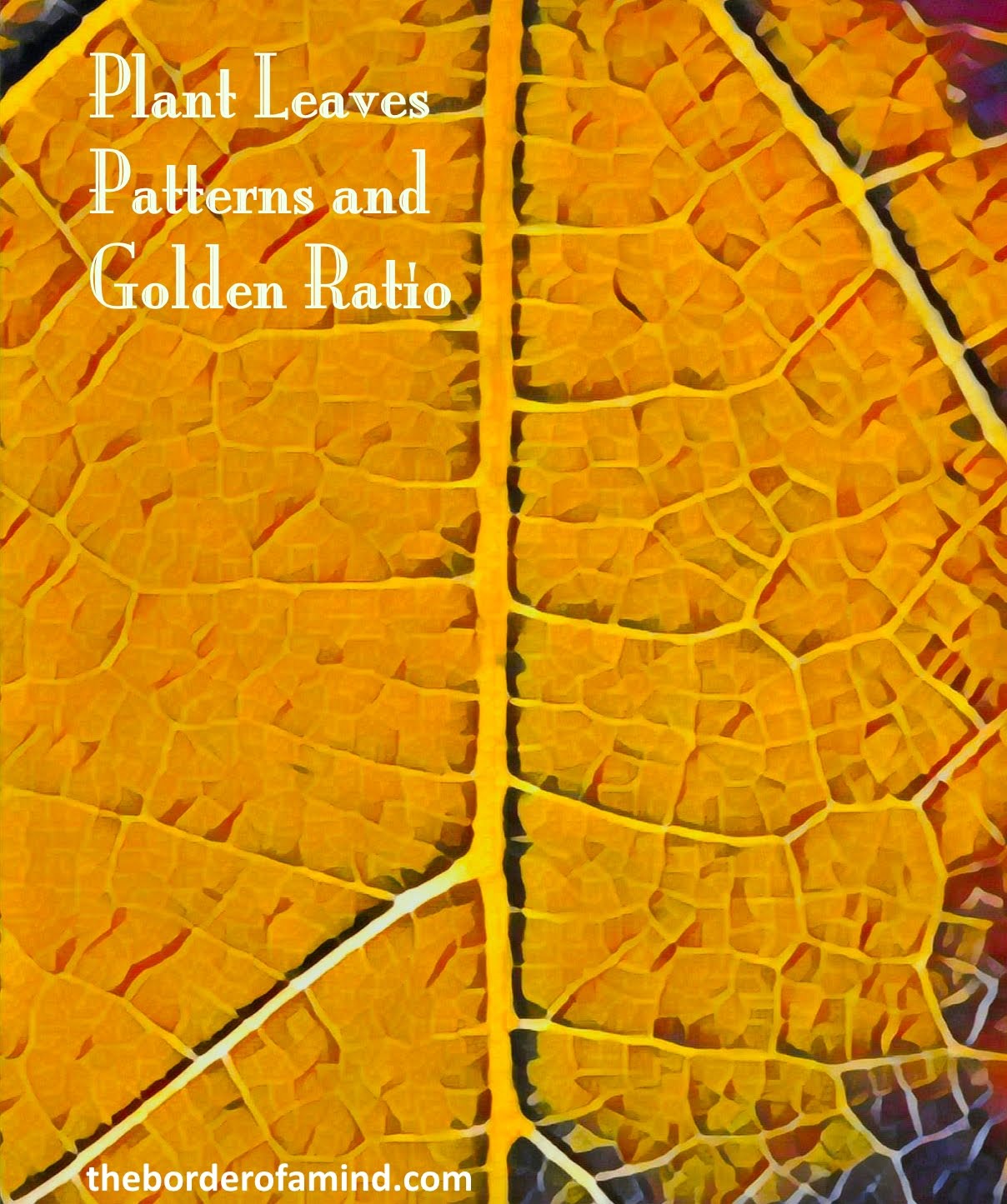
The golden spiral can be found in pinecones, sunflowers, pineapples, and a lot of other plants. Another amazing detail is that the petals of plants commonly grow in Fibonacci numbers.
In sunflower, we can notice two families of spiral patterns: one winding clockwise and the other counterclockwise. The quantity of spirals in each family are always two consecutive Fibonacci numbers. This effect is the result of closely packing points separated by 137.5 degrees in tight spirals. This implies that the a golden-ratio based phyllotaxis allows not only for optimal sun exposure but also for maximal packing in horizontal space. (Reference)
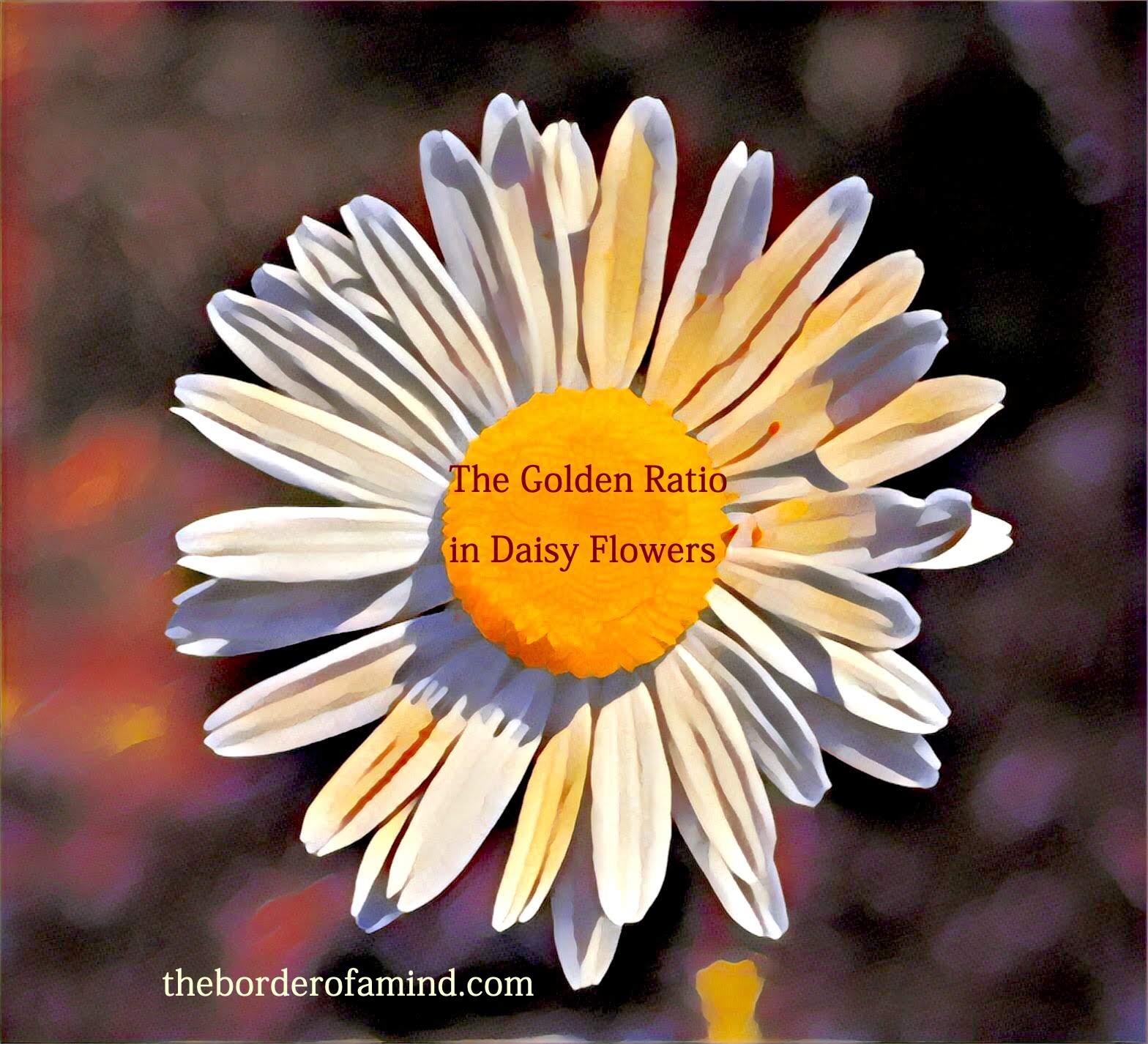
For field daisies, the count of petals is usually either thirteen, twenty-one, or thirty-four petals, all consecutive Fibonacci numbers. Bet you didn’t know about this before! 🙂
And it’s not over yet. We have more!
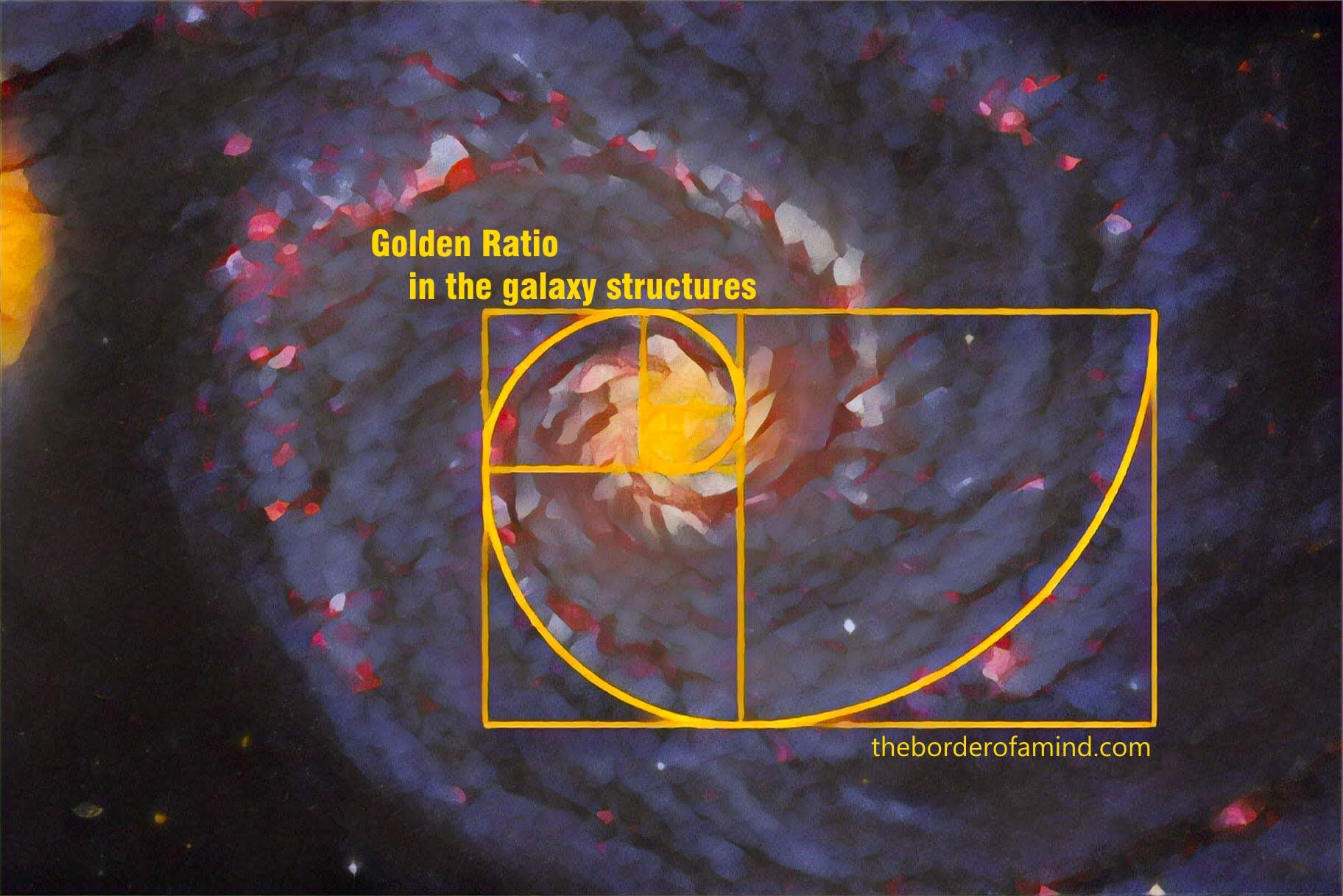
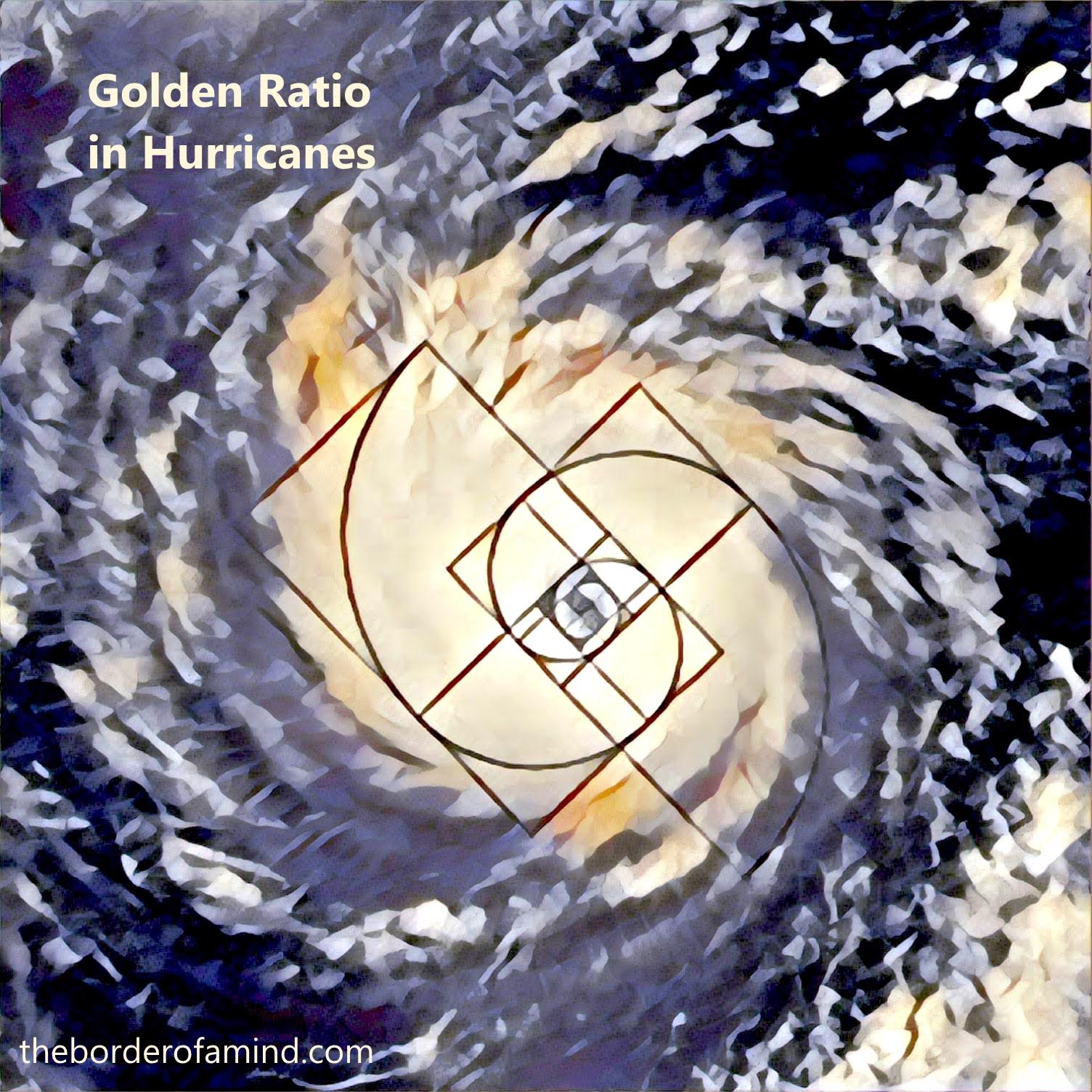
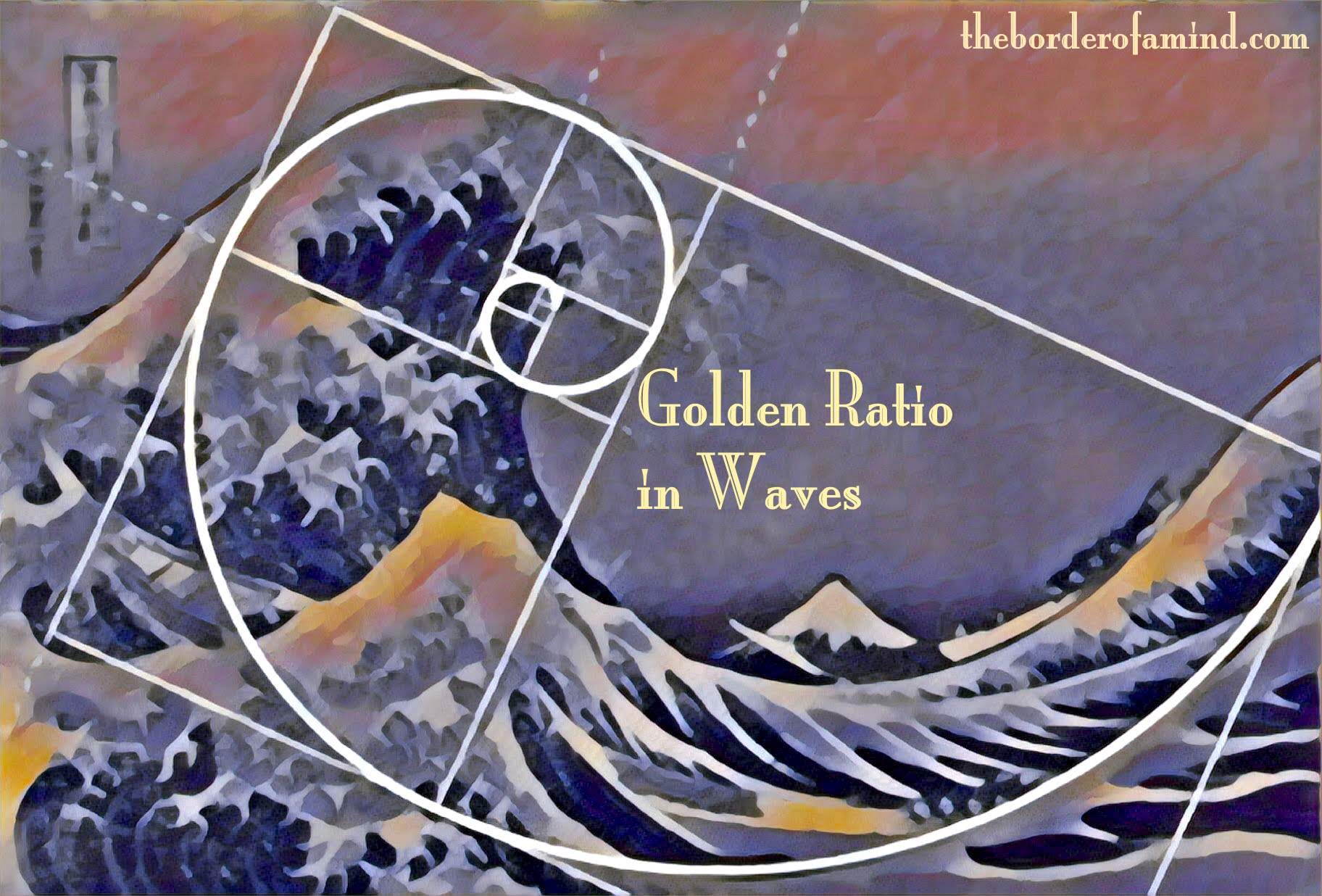
The golden ratio is even found in the shape of galaxies, hurricanes, and waves.
What I have shown here is only a small portion or subset of how this golden ratio pervades in almost every other stuff we are surrounded with. Leonardi Davinci has used this ratio in some of his greatest paintings. Architects use this ratio in designing structural solutions with better aesthetics. In architecture, they bring balance and height to structures and allow the usage of specific geometries and varying shapes and eventually help build aesthetic structures. They are also extensively used in arts and music as well. The ratio is made use of in the design of several musical instruments and in timing musical compositions (Climax reaching at 61.8% of the song sequence to make it more appealing, for instance). Beethoven’s fifth symphony uses this ratio. The ratio is also used in other fields like facial plastic surgery and cosmetic dentistry. This is really thought-provoking. If we ponder deeply on these realities, we come to the realization that everything around us is formed and ordered in a measure which we even don’t notice. We require the eye of wisdom and insight to contemplate these realities. Don’t let these astonishing marvels around you hide from your thoughts and cogitations when we get engulfed ourselves in the blurred rush of routine life. Uncovering this hidden mathematical miracle around us has a profound impact. Think about it, friends! Let’s widen our horizons and augment our perspectives. Personally, I believe this ratio is sort of like a divine signature. God bless friends!
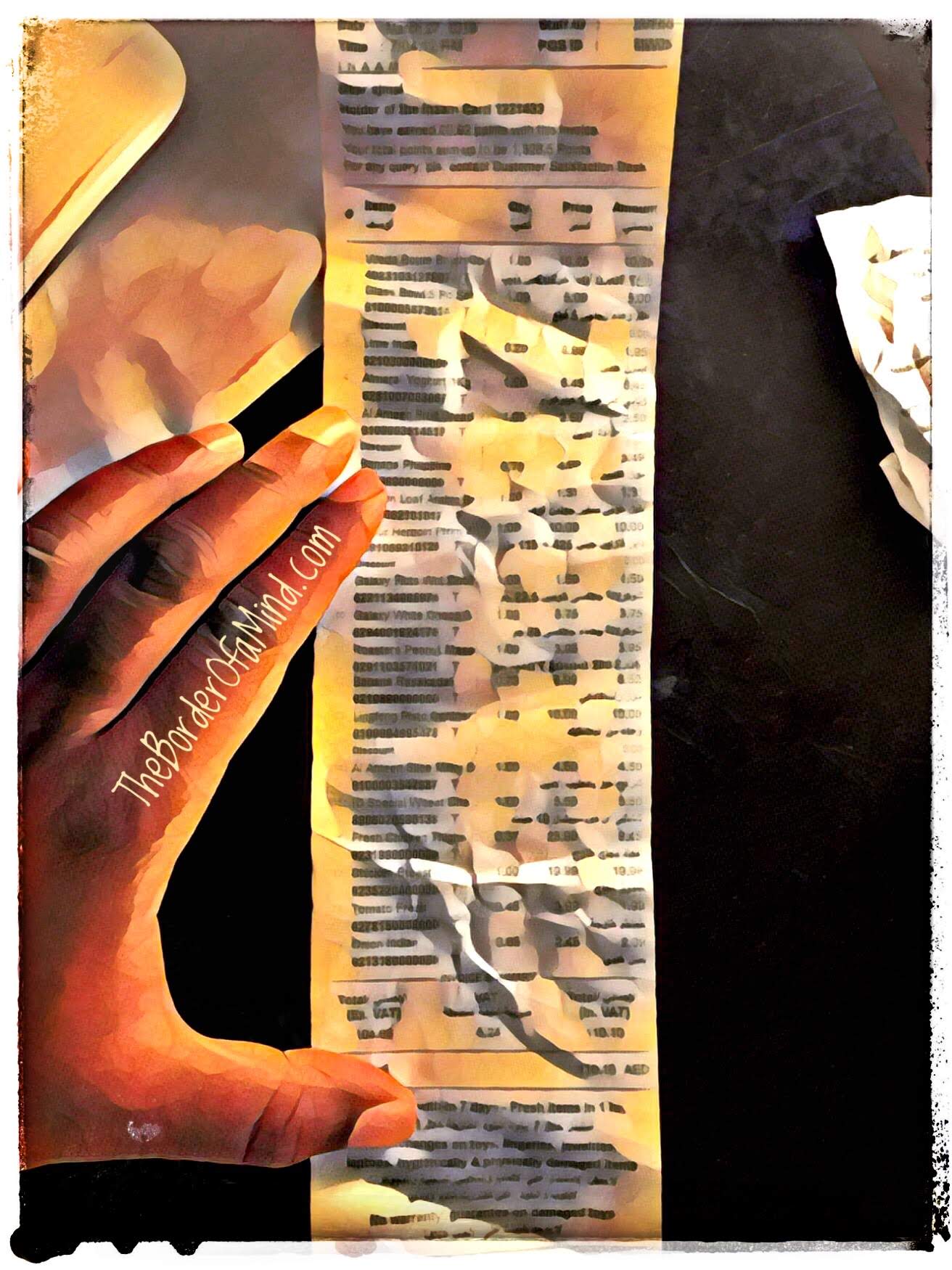
We are living in a world wherein documentations are increasingly handled digitally and governments and institutions are pacing swiftly towards a paperless future. Every one of us has important documents that we need for different purposes. These important documents may include your national ID card, passport, driving license, ATM cards, credit cards, health cards, vehicle licenses, insurance documents, visa copy (in case if you are an expat living in a foreign country), any other relevant certificates, etc. There are instances when we need to have them shown or submitted for a variety of administrative or clerical purposes. People generally have their digital versions scattered all around the place. Either it might be in an email abyss or in some pen drive or some cloud service which is not organized well. The core reason for relying on digitization of any sort of document is retrievability. If we cannot retrieve a particular document when it is exactly required, that defeats the purpose of documenting them in the first place. In this post, I shall share some of the ways that I have been using for several years now for digitally organizing documents.
The first thing is to have a scanning app on your phone. My recommendations are Scanner Mini and Microsoft Office Lens. This will help you to quickly scan any paper documents you’ve. After you have the documents scanned and available, you can try any of these options:
Google photos has been really useful for everyone to organize their photos very conveniently and curate them well using AI technology. But we can use it as a tool for storage and retrieval of our documents as well. Let’s say you have a driving license to be scanned. Use any of the apps specified above and get it scanned as an image. Rename them as “Driving License” and save them to Google Photos. In Google photos, select this photo and add it to a new album and rename it as “Driving License”. So the next time, when you’re outside and you quickly need to have the soft copy of your driving license, just search by “Driving license” in your Google photos library, and the license would pop up as an album. I recommend spending an hour digitizing all the important documents that you may need to retrieve for any purpose.
In the same way, cloud backup services like Dropbox, Box or Google Drive shall also be used to store these documents. All the relevant documents can be properly named and archived with any of these services. The same approach can be also used for other documents like receipts, certificates, etc as well. Scanning alone is not sufficient. Archiving is closely tied with a proper identifiable organization of these documents and their swift retrieval. Archival, identification and retrievability need to be a cohesive process. Each person has got different sets of requirements and the way of archival would also be different. The key is to adapt the method that is the most effortless for you.
We can’t underestimate the convenience and ease of use that this practice of digitizing documents and organizing them properly ensues in our daily lives. Let’s be more organized. God bless!
I happened to see this interesting message in a forum and thought of sharing it with readers. My firm conviction is that a little restraint, patience and calmness in dealing with a situation would definitely drastically change the course of it in ways unthinkable. It applies to all spheres of our lives, professional and personal. Regardless of any avenue we are in, we would be continuously fed with opportunities to mend and grow our patience. As Rodney Williams famously said, “Patience is the gift of being able to see past the emotion“. Being relentless in having a calm composure is not easy, but that’s something we shall try our best for, considering the empathy and kindness they directly ensue. God bless.
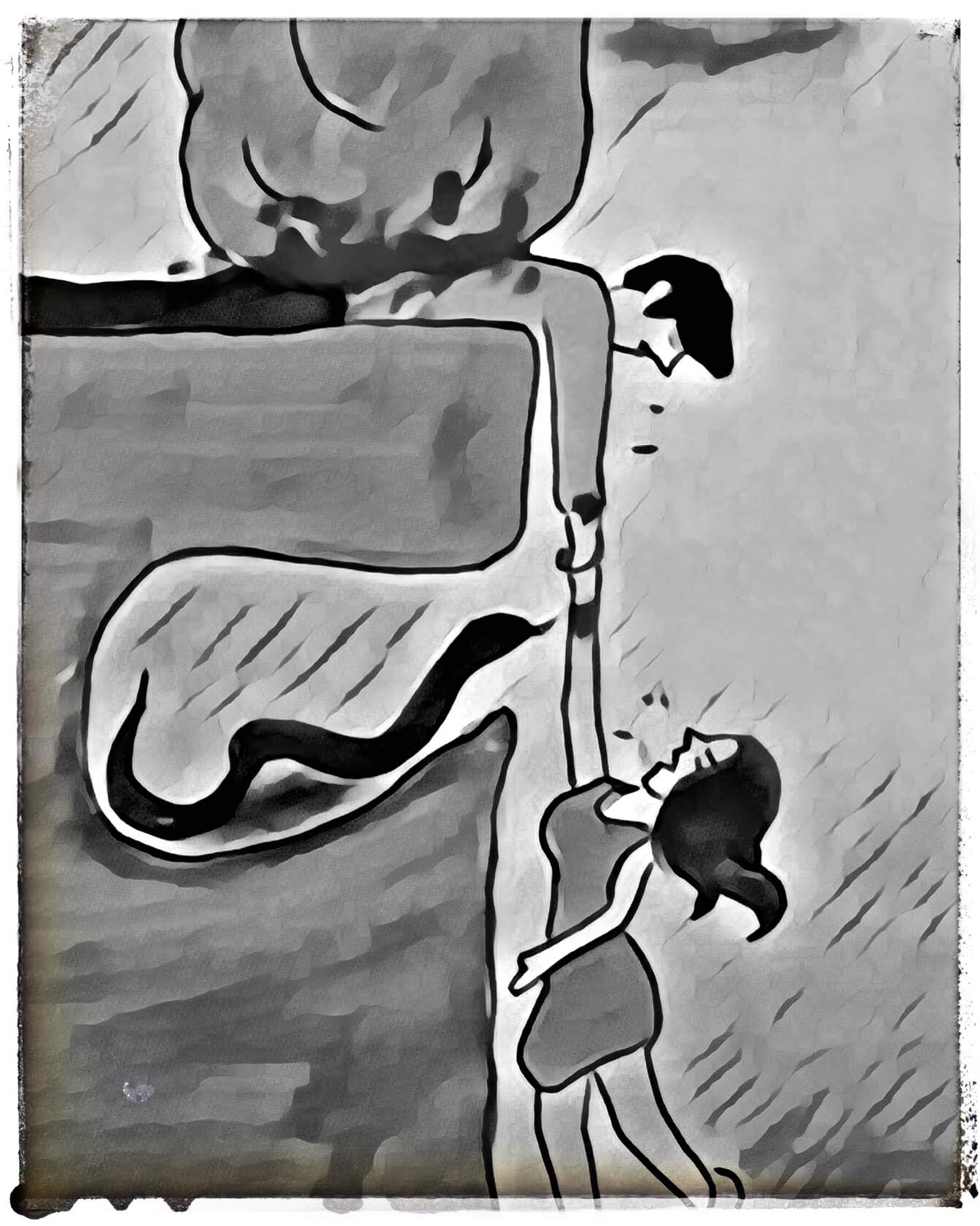
The man doesn’t know that there is a snake underneath. The woman doesn’t know that there is a stone crushing the man. The woman thinks: “I am going to fall! And I can’t climb because the snake is going to bite me! Why can’t the man use a little more strength and pull me up!” The man thinks: “I am in so much pain! Yet I’m still pulling you as much as I can! Why don’t you try and climb a little harder!?” The Moral is : you can’t see the pressure the other person is under, and the other person can’t see the pain you’re in. This is life, whether it’s with work, family, feelings or friends, we should try to understand each other. Learn to think differently, perhaps more clearly and communicate better. A little thought and patience goes a long way. Be kind to people. Everyone we meet is fighting their own battle.
As a part of my job, I do engage with the design of lots of structural components used on bridges like bridge bearings. The literature and work-related adherences normally intimidate me to see bridges with a very technical eye. Along with the technicality and the engineering behind them, it was really interesting to take a listen at this wonderful TED talk by Ian Firth, the famous British structural engineer and bridge designer which interestingly wasn’t about technical jargon, but the spirit behind why bridges are built and the beauty and passion that has to subsumed with the design, engineering and procurement behind them.
As he says in the talk, bridges are not just a safe way about a river or an obstacle, they shout about connectivity and community. He quotes several examples of how bridges empower people and communities. He walks us through the history of bridge construction and the different materials and technology options used during those times as well as brilliant synergies of architecture and engineering with examples of cable suspension bridges and fiber reinforced concrete to sculpt marvelous concrete bridges, that often becomes part and symbol of the regional landscape of certain places. I really loved the wonderful postulation of building bridges that are beautiful and elegant and at the same time are safe, durable, functional and serviceable. He says:
” We tend to design bridges for 100 years plus. They’re going to be there for an awfully long time. Nobody is going to remember the cost. Nobody will remember whether it overran a few months.But if it’s ugly or just dull,it will always be ugly or dull. Bridges — beauty enriches life. Doesn’t it? It enhances our well-being. Ugliness and mediocrity does exactly the opposite. And if we go on building mediocre, ugly environments — and I believe we’re becoming numb to that stuff — if we go on doing that, it’s something like large-scale vandalism, which is completely unacceptable. ”



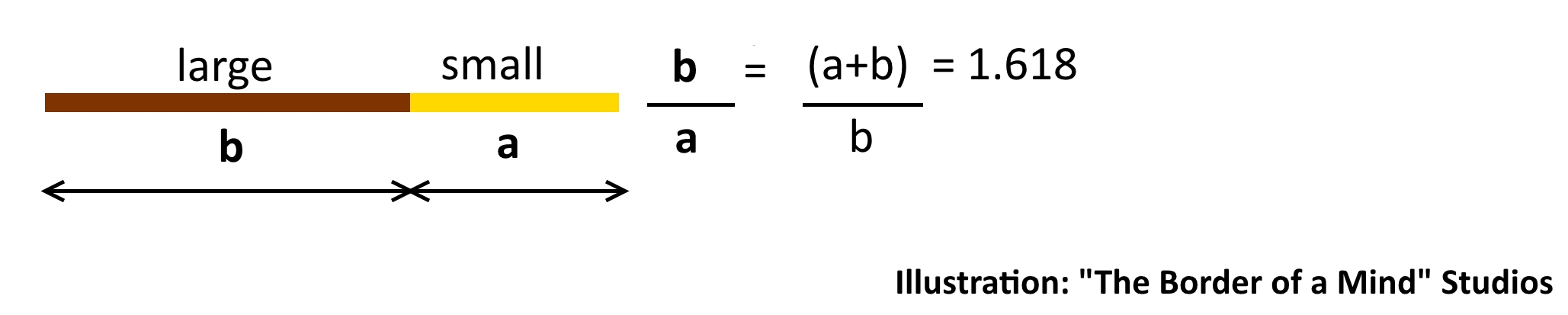
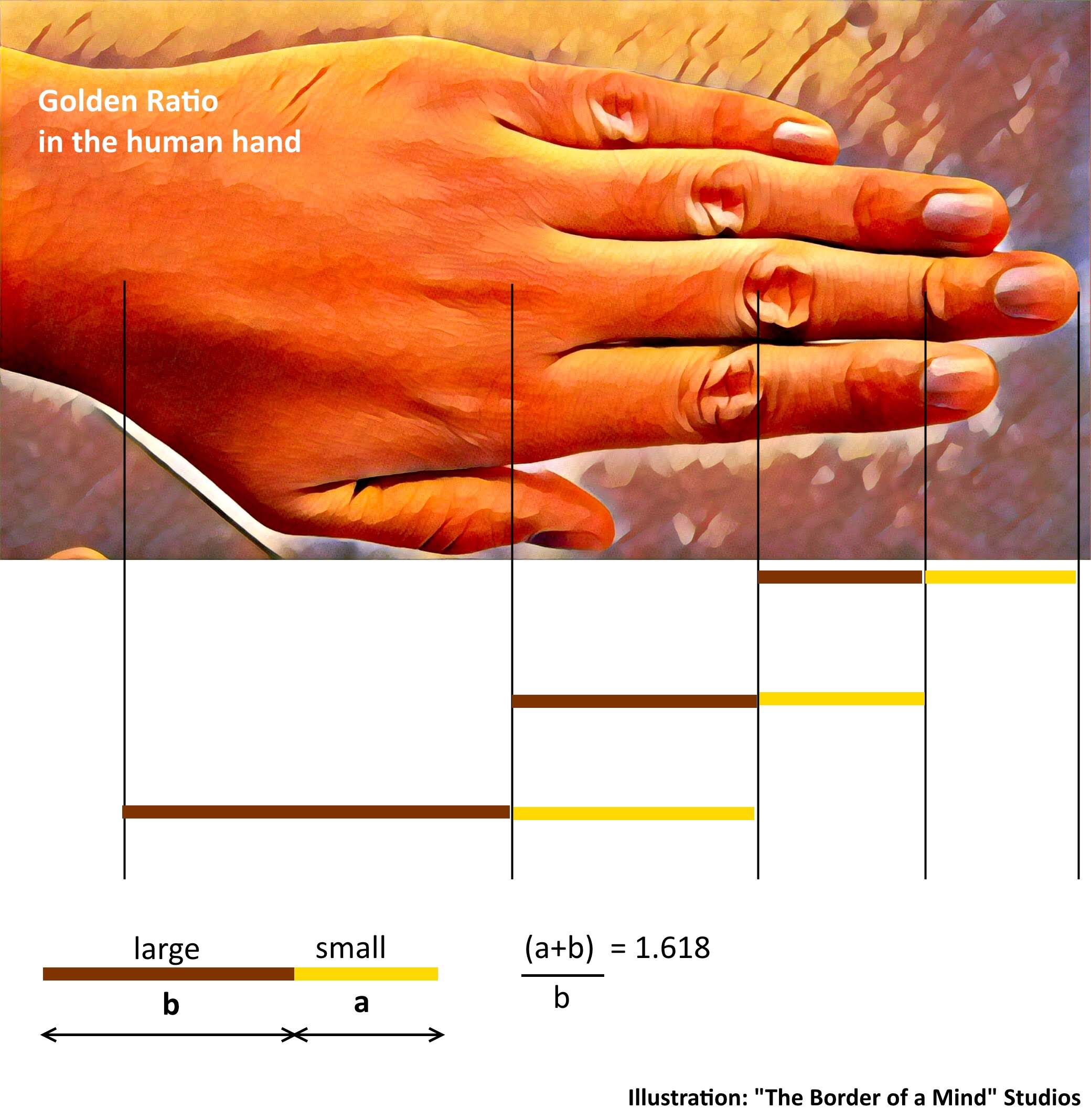
 Now, that’s far from over. Let’s go a little deeper. The same ratio is true for the below: