gift of the night

The world changes when the sun goes down. The same streets, the same rooms, the same sky, all take on a different weight in the quiet of the night. Sounds stretch longer, thoughts grow louder, and everything feels just a little more raw, a little more real. At night, we feel things we push aside during the day. Regrets resurface. Longing sharpens. Memories become clearer, more vivid, as if the dark makes space for the things we have been avoiding. The questions we ignore in daylight come knocking, asking to be heard. But night is not just a time for heavy thoughts. It is also when ideas come alive, when creativity stirs, when solitude feels less like loneliness and more like possibility. There is a softness to the night, an intimacy in the way it wraps around us, making room for reflection, for stillness, for things that don’t need to be spoken aloud. And then, just as quietly as it arrived, night fades. The sky lightens, the world wakes up, and everything that felt so intense under the moon begins to soften in the light. What seemed impossible in the dark suddenly feels manageable again. Maybe that is the gift of the night, it allows us to feel deeply, but it does not ask us to carry it forever. Because no matter how heavy the night feels, morning always comes.

light switches

Without realizing it, our hands find the same light switches every day, morning, night, and all the quiet moments in between. The soft click signals the beginning of something, or the end. It’s a habit so ordinary, so unnoticed, that we rarely think about it. And yet, it quietly shapes the rhythm of our lives. One switch means the day has begun. Another signals it’s time to rest. A hallway light clicked on in the middle of the night tells the story of a child waking from a dream, a mind restless with thought, a soft search for water or peace or calm. These switches become emotional landmarks. We remember the one we reached for after hearing bad news. The one we turned off before leaving a place for the last time. The one left glowing when we waited for someone to return. It’s strange how something so small becomes part of our emotional architecture. We don’t notice until it changes, a move, a renovation, a burned-out bulb, and suddenly, our hands fumble, our rhythm is disrupted. In a way, light switches are a quiet form of memory. They hold routine. They hold mood. They hold presence. And every click is a decision, to step into light, or to return to the dark. To begin again, or to let the day rest.

Lantern in the clouds

Moon

The quality of this photograph is not in line with the usual standards that we look up to, but I wanted to record this beautiful moment that I experienced at night. The room that we sleep in has these glass panes on one side of the wall. It allows us to gaze at the sky when we lie down and the usual pastimes include wondering at the cloud patterns forming or to count the number of flights passing through. (We live somewhat near to the airport). One night, the moon was full and it was flourishing on the clouds and Netta woke me up to show this. Although the photograph couldn’t even capture one-hundredth of the magnificence of this frame, I vibrantly remember the view.

..“It is a beautiful and delightful sight to behold the body of the Moon.”

― Galileo Galilei,

The Starry Messenger, Venice 1610: “From Doubt to Astonishment”

convergence of faculties

This photograph would easily be one of my recent favorites in terms of framing. I was staying on a traffic lane and the car just stopped at this beautiful frame at the centre, as if this moment of click was to converge and fall in place like a click of a button or a tight latch. Although the overly done post-processing is off the roof, I just wanted it to be illuminated this way.

Convergence of Faculties, Photographed at Muweilah suburb in Sharjah Emirate, UAE, October 2020

“To photograph is to hold one’s breath when all faculties converge to capture fleeting reality. It’s at that precise moment that mastering an image becomes a great physical and intellectual joy.”

― Henri Cartier-Bresson, The Mind’s Eye: Writings on Photography and Photographers

furnishing head.

Decor and lights are something that always steers me to explore my old archives.
“I’m more preoccupied with furnishing my head than the place where I live. The most beautiful rooms I have entered have been empty ones.”
― Yann Martel, The Facts Behind the Helsinki Roccamatios


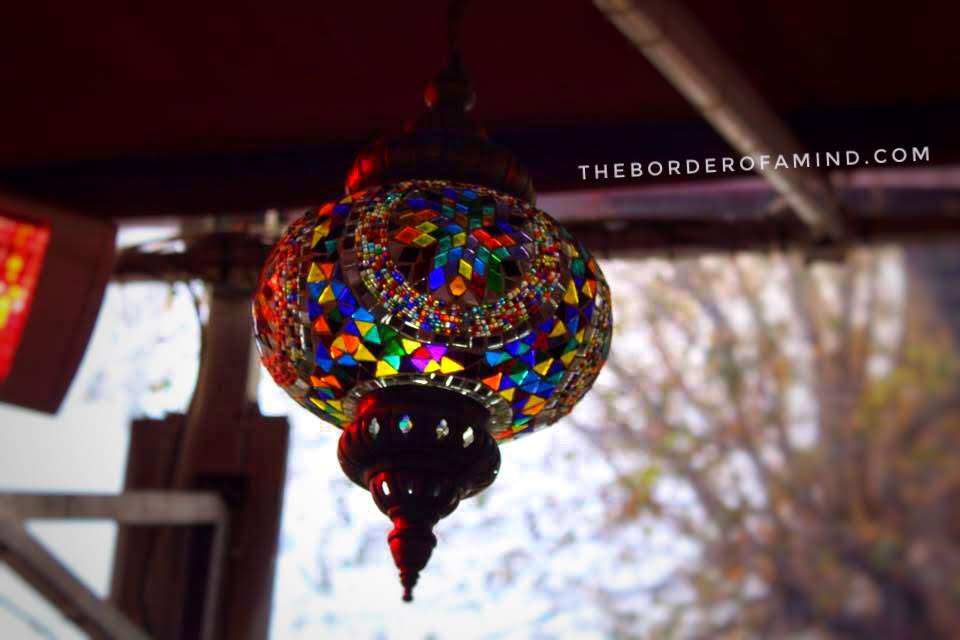
mosaic lamp eloquence

All of us who have traveled through the wider Middle East in all probability would have stumbled across one of these beautiful lights. These are Turkish mosaic lamps.  Turkish lamps have a long history, the technique of producing these lamps started 5,000 years ago in its earlier forms. They had their early debut during the Ottoman era. Until the 19th century,  candles and oil lamps were predominantly used for illuminating palaces and mansions. Before the spread of electric lamps, these lights were important symbols of rich heritage and civilization. Oil lamps were produced in the form of glass bottles or cup-shaped jars suspended from a chain. Bathhouses, mosques, and arenas of Istanbul were lit with these oil lamps. Over time, colored glass panes were used artistically with these lamps and they turned out to be even more beautiful. These are usually handmade and are an important element of Turkish and Anatolian roots and culture. We’d find variants of these types in other cultures as well. It’s an art and a skill to prepare hand blown glass which is cut from large sheets of different sizes and colors. A transparent, permanent but slow drying adhesive is applied to a small section of the base with a noticeable pattern through the adhesive to direct the artisan’s hand and there are several other steps to completion. Each one carefully crafted is a piece of art and expertise. I picked one from a journey to Istanbul in 2014.


Reflecting on Shadows

If you remember, we started the ponder series by a small post about perceptions. Today, we’re thinking about something very subtle that we don’t think about much – shadows. For our new readers who aren’t familiar with this series, Ponder Series is an initiative from The Border of a Mind Studios in exploring and pondering on those miraculous themes all around us to which we shut our eyes and thoughts to in the daily life gallops.

A shadow is technically a region of darkness that forms on a surface when an object is between a light source and the surface. The shape of the shadow resembles the periphery and outline of the object casting the shadow. For example, when we shine a torch on a wooden box sitting near a wall, the wooden box outline would be the shadow cast on the wall. Although this looks pretty straightforward, the size of the shadow is depended on several factors. The primary thing is the distance of the object from the light source. When the object is closer to the light source, it casts a larger shadow. When the object is closer to the light source, the shadow is of a smaller size. Also, inclinations also have an influence on the outer periphery of an object cast as a shadow. When we see something in front of us, what we’re seeing a visual representation of it at the visual center at the back of our brains. We’re not seeing the “original” of what is in front of us, but a copy at the back of the brains. Imagine a view of a busy street with people walking and cars on the way. This “image” is seen at the back of our brains. Brain researchers working on the subject have found out that if a person resting in a lab is fed with these “signals” of a street, they’d feel that they’re in the street when actually they’re not. The image in the visual centre at the back of our brains is so perfectly rendered in all its 3-dimensional feel and layering such that we mistake it for the original without thinking that it’s only a copy that exists in our minds. Among the several factors that make this so convincing like distance, light, depth and colors, one important aspect in making this visual experience so real is shadows and shades. Artists, painters, and craftsmen use shadows as a tool to give a sense of depth and realism to a work of art by traversing avenues of shades and perspectives. If we look at the world around us, the shadows are intertwined so miraculously around us forming the visual experience we savour and we don’t even notice it as it’s so entwined in our vision. I truly believe that’s the masterful craftsmanship of the Almighty.

“Feeling at peace, however fragilely, made it easy to slip into the visionary end of the dark-sight. The rose shadows said that they loved the sun, but that they also loved the dark, where their roots grew through the lightless mystery of the earth. The roses said: You do not have to choose. 

Robin McKinley, Sunshine

sprouting skylines

A sunset drenched view of an elegant Dubai skyline captured sometime before 2014. Sunlight is painting.

“ Pilgrims from all over the world were making their way to the place deemed the pearl of the Middle East. The city was reminiscent of a modern-day Persepolis. Its buildings, like towering pillars, tested the sky’s limit. The evenly paved roads belched with the smell of new tarmac, as if a million masons woke up every morning and by hand lay asphalt one grain at a time. People of all colors, ethnicities, creed and social statuses came bearing money, knowledge or experience in order to build their legacies in the new kingdom, sprouting out of the desert. Dubai had arrived. ”

― Soroosh Shahrivar, The Rise of Shams