garden of thoughts.


Recently I read a very interesting post on what really matters on what you build and long for. It can be anything – it can be a product, a service, experiences, personal connections, travel spaces, mindset, you name it.

“Do you see all those people who whipping their smartphones out as soon as they get on the train or stand in a queue? They’re not just avoiding boredom, they’re searching—but not only for information, or laughs, or updates. They are searching for a feeling of connection.

We want places to go and places to be. Places to kill time and places that make us feel a little less lonely in the moment. Places to learn. Places to share. Places that make us feel safe, or smart, or welcomed, or funny, or hopeful for the future. But most of all, we want places to belong and places where we feel like we matter.

Those places used to be our family homes, our dinner tables at 6 pm, or football games with friends on Saturday afternoons. Increasingly they are digital spaces.

Whatever you’re building, think beyond features, functionality and design and think first about how the person you serve wants to feel when she arrives at the place you’ve built.” [ source ]

This is exactly on the nail on how I conceive and present the soul of The Border Of a Mind to you as a valuable reader. As I wrote previously, I put my heart and soul into every little word, graphic and theme that you find inscribed here. In this world of bustle and commotion, I always love to prepare this place as sort of a virtual garden of my thoughts and whisk it with some spice of original arts and photography.

transience.

We have spoken about fragility in the same thematic context before.  I happened to read about the concept of  Mono no aware frequently referred to in Japanese culture.

“Mono no aware, literally “the pathos of things”, and also translated as “an empathy toward things”, or “a sensitivity to ephemera”, is a Japanese term for the awareness of impermanence, or transience of things, and both a transient gentle sadness (or wistfulness) at their passing as well as a longer, deeper gentle sadness about this state being the reality of life. “Mono-no aware: the ephemeral nature of beauty – the quietly elated, bittersweet feeling of having been witness to the dazzling circus of life – knowing that none of it can last. It’s basically about being both saddened and appreciative of transience – and also about the relationship between life and death.”

Often this concept is referred with an allegory of Japanese Cherry Blossom season in Japan which is known for its perhaps more “visible” transience. The below petals are from my office garden. The same plant in different stems conveys the unavoidable transience of life. While one of the petals is on a bloom, the other one slowly withers away.

Taylor Bond, in her wonderful article, puts it very elegantly:

“What comes most easily to mind is the beauty of the cherry blossom; the flower blooms intensely, yet only for a short period of time each year. As the flowers die and the petals fall, cherry blossoms line the streets like a layer of soft, pink snow, and are most beautiful when captured between the precipice of life and death. That is precisely the unique appeal of the cherry blossoms; their aesthetic focuses on the unavoidable transience of the material world that exists. According to this view, the fragility and inherent brevity of an instance of awe, such as the blooming of the cherry blossoms, only aids in heightening the event’s stunning, albeit melancholic nature. Because it only lasts for such a short period, it is undoubtedly appreciated more. Understanding and accepting that innate uncertainty of life helps us evade the overwhelming feeling of morbidity associated with impermanence, instead highlighting our ability to enjoy life by appreciating its fleeting moments. The unavoidable nature of finite existence is contrasted with the never-ending stream of change, as life continues to occur despite the continuous passing of objects and experience. The realization of impermanence is therefore bittersweet, tinged with mourning, and yet also capable of recognizing the beauty of change in itself.’

Similar thematic allegories are also narrated in scriptures.

And cite for them the parable of the present life: it is like water that We send down from the sky; the plants of the earth absorb it; but then it becomes debris, scattered by the wind. God has absolute power over everything.” (Q’ 18:45)

Kintsugi.

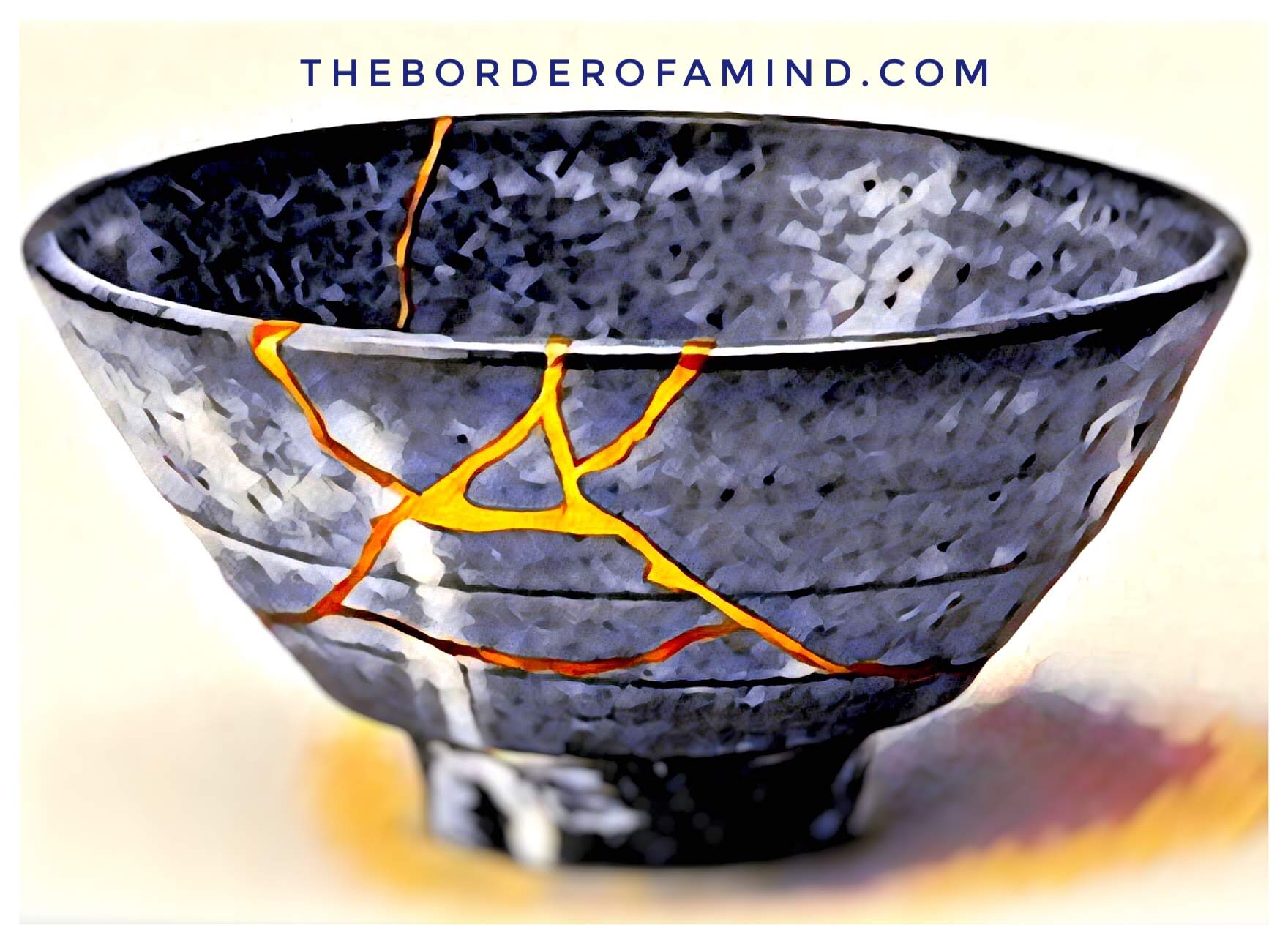
I had written on this page about Kintsugi. It’s a very interesting Japanese concept. It’s widely used in art and pottery but what’s even more enthralling is its philosophic extension that’s often found to cognate with healing and history. In this concept, broken and repaired things are often regarded as much more beautiful. It’s often read in the context of Wabi-Sabi, which is basically “to explore the beauty in broken things or old things.” I have read a little book explaining this concept and I felt it was wide implications.

” Kintsugi (金継ぎ, “golden joinery”), also known as Kintsukuroi (金繕い, “golden repair”), is the Japanese art of repairing broken pottery by mending the areas of breakage with lacquer dusted or mixed with powdered gold, silver, or platinum, a method similar to the maki-e technique. As a philosophy, it treats breakage and repair as part of the history of an object, rather than something to disguise. “

Barbara Bloom puts it this way: “When the Japanese mend broken objects they aggrandize the damage by filling the cracks with gold because they believe that when something’s suffered damage and has a history it becomes more beautiful“.

Omid Safi writes in his piece “Illuminating the Beauty in Our Broken Places“,

” We value success, wholeness. Unlike this Japanese art form, we don’t yet have a way of looking for what was once broken and has been healed and illuminated. How lovely would it be to find that a cracked and illuminated cup can be even more beautiful than a whole cup. How wise to realize that the broken hearts, illuminated and made whole, can be even lovelier.”

incremental fruition

I happened to read this share from Netta recently. We can easily relate instances wherein *boredom* sets in and sabotages a goal we had. This can often permeate for short term or even long term plans.

“The greatest threat to success is not failure but boredom. We get bored with habits because they stop delighting us. The outcome becomes expected. And as our habits become ordinary, we start derailing our progress to seek novelty. Perhaps this is why we get caught up in a never-ending cycle, jumping from one workout to the next, one diet to the next, one business idea to the next. As soon as we experience the slightest dip in motivation, we begin seeking a new strategy—even if the old one was still working. As Machiavelli noted, “Men desire novelty to such an extent that those who are doing well wish for a change as much as those who are doing badly.”
– James Clear, “Atomic habits”


Setting a goal or a vision often gets accompanied by an action roadmap that includes small incremental achievable actions that count on to gradually achieve the vision or goal we had in our minds. My experiences and intuitions have induced me not to be stagnant at any stage and always be proactive and positive with incremental steps towards a goal set. Of course, we go through slips that are human by nature. It’s often in these small cumulative steps that we often stumble and fail in walking towards a dream or purpose. While writing this, I recollect an interesting conversation that I had listened to sometime in 2016, between Walt Mossberg and Jeff Bezos wherein Jeff mentioned his keenness to be  “stubborn on the vision, but flexible on the details“. Maintaining enthusiasm towards the end of a long term project or objective is paramount. What is more interesting is that it is in these small gradational steps or stages wherein the passion for working towards a dream is to be invigorated. Seeds of boredom often enfeeble these small steps that we embark on and gradually jeopardize the goal. That’s probably the reason why the single most important thing in working towards a vision is to systematically and consistently maintain the enthusiasm throughout. Within the bounds of our inherently humane weaknesses, when someone gets through, that’s how greatness sprouts. Dreams are often lost in the details. In fact, details and path embarked are cardinal in major fulfillments. May passion and fervor fuel your hopes and aspirations. God bless friends! : )


kindness.

I happened to see this interesting message in a forum and thought of sharing it with readers. My firm conviction is that a little restraint, patience and calmness in dealing with a situation would definitely drastically change the course of it in ways unthinkable. It applies to all spheres of our lives, professional and personal. Regardless of any avenue we are in, we would be continuously fed with opportunities to mend and grow our patience. As Rodney Williams famously said, “Patience is the gift of being able to see past the emotion“. Being relentless in having a calm composure is not easy, but that’s something we shall try our best for, considering the empathy and kindness they directly ensue. God bless.

The man doesn’t know that there is a snake underneath.
The woman doesn’t know that there is a stone crushing the man.
The woman thinks: “I am going to fall! And I can’t climb because the snake is going to bite me! Why can’t the man use a little more strength and pull me up!”
The man thinks: “I am in so much pain! Yet I’m still pulling you as much as I can! Why don’t you try and climb a little harder!?”
The Moral is :
you can’t see the pressure the other person is under, and the other person can’t see the pain you’re in. This is life, whether it’s with work, family, feelings or friends, we should try to understand each other. Learn to think differently, perhaps more clearly and communicate better. A little thought and patience goes a long way.
Be kind to people. Everyone we meet is fighting their own battle.

I encourage to read through The Parable of Mexican Fisherman.

Lunar Silhouette

This Illustration is based on an original photograph by dear friend MHP. This was taken when we strolled into some of the beautiful inner desert ranges in the Emirate of Sharjah, UAE. We initially went to photograph an eclipse but some cloudy patterns prevented us from taking the customary eclipse photograph and our roaming there was destined to be protracted for that perfect snap. The frame that you see was always there in the back of my mind. I’m always fascinated by celestial entities and is unapologetically fervid about stargazing. The beauty of glancing at them comprises the pattern in which they manifest of our feebleness in the grand magnificence and grandeur of the vast universe. For me, stargazing is about embracing humility and lightness. I somewhat feel the same with mighty mountains as well.

In the beautiful poetry of Serbian poet and essayist Dejan Stojanović,

To hear never-heard sounds,
To see never-seen colors and shapes,
To try to understand the imperceptible
Power pervading the world;
To fly and find pure ethereal substances
That are not of matter
But of that invisible soul pervading reality.
To hear another soul and to whisper to another soul;
To be a lantern in the darkness
Or an umbrella in a stormy day;
To feel much more than know.
To be the eyes of an eagle, slope of a mountain;
To be a wave understanding the influence of the moon;
To be a tree and read the memory of the leaves;
To be an insignificant pedestrian on the streets
Of crazy cities watching, watching, and watching.
To be a smile on the face of a woman
And shine in her memory
As a moment saved without planning.

Said Nursi writes:
The beauty of a finely worked object points to the beauty of the craftsmanship. The beauty of the craftsmanship points to the beauty of the name which was the source of the craftsmanship. The beauty of the name of the craftsman’s art points to the beauty of the craftsman’s attributes manifested in that art… The magnificent cosmos is a palace that has the sun and the moon as its lamps and the stars as its candles; time is like a rope or ribbon hung within it, on to which the Glorious Creator each year threads a new world.

change | influence | build


In my recent article “Instilling Compassionate Prudence“, I had touched upon the theme of giving the extra effort and aspiring to emboss our signature and professional acumen in any kind of work we are engaged in, be it in any realm. This post is kind of an extension of that theme and in a way, augments those frameworks discussed. Quoting from a very old interview with Steve Jobs (1955 – 2011),

When you grow up you tend to get told the world is the way it is and your life is just to live your life inside the world. Try not to bash into the walls too much. Try to have a nice family, have fun, save a little money. That’s a very limited life.

Life can be much broader once you discover one simple fact: Everything around you that you call life was made up by people that were no smarter than you and you can change it, you can influence it, you can build your own things that other people can use.

Once you learn that, you’ll never be the same again

These changing, influencing and building aspects are truly profound. Be it a job or a project or any sort of endeavor, we are basically streamlined to do any of these on a broader viewpoint in the grand scheme of things.

Steve further notes:

” And the minute that you understand that you know if you push in, something will pop out the other side that you can change, you can mold it. That’s maybe the most important thing is to shake off this erroneous notion that life is there and you’re just going to live in it versus embrace it, change it, improve it, make your mark upon it. Once you learn that, you’ll never be the same again.”

Instilling Compassionate Prudence

I always dream of this societal framework everywhere wherein, every person gives his best in whatever they do. Even if he/she’s a novice, I truly believe one can perfect his craft by being proactive, enthusiastic and passionate about what they do. This sort of prudence is something that can positively impact anyone you engage with. On a broader realm, this applies to companies and their engagement with customers and if we move further broad, that’ll change the world. For instance, if somebody is working in a customer care team, he can put in extra effort to bit more gentle and considerate with their clients. Being too gentle may not required by work scope, but that really makes a difference. Similarly, an artist who works professionally can put in extra bits and pieces to make his craft bit more detailed and enriching. Imagine a gardener charged with the task of pruning certain plants as a part of his job. Seemingly monotonous in the first instance, he can put in extra effort to make his output much more beautiful and add his personal touch to it. I had previously written something about “job from the heart“.  We’re not talking about meeting customer needs, but exceeding what they expect from you. This sort of a spirit truly brings in sort of fulfillment in everything that we do. This urge of always trying to give our best, improving ourselves and perfecting our craft helps us grow internally.  And the best way to be prudent is to make our best efforts to surround ourselves with people who uplift us, encourage and compliment us. This is not a motivational note or something similar, but I always thought of writing about this wholesome approach of instilling prudence in whatever we do.

Be it any work that you’re engaged in, I wish it to be filled with beauty, positivity and a state of mind often manifested in the quality of work we deliver. This sort of engagement with other people in different realms of life is what I believe defines us on a deeper note.  God bless you, friends!